Thursday, February 22, 2018

Streedagh Strand – Spanish Armada Shipwrecks

Streedagh Strand Memorial
Photograph (c) Richard Golden

Streedagh Strand is peaceful and quiet now. The cries of those souls who tragically perished there are no longer heard and over four centuries of tides have washed away their blood.
In September 1588 three ships of the Spanish Armada were wrecked off Streedagh Strand on the coast of Sligo. They were caught in a sudden violent storm that raged over a three-day period, culminating in the destruction of the ships and the loss of over 1,000 lives. The ships were La Lavia, of Venetian origin, Santa Maria de Visóri from Ragusa (Dubrovnik) and La Juliana from Barcelona.
In 1985, a group of English divers - known as the Streedagh Armada Group (SAG) - discovered the wrecks. Following some investigative work at the time, many artefacts were recovered, including three guns from the wrecks of La Juliana and one from La Lavia.
Protracted legal proceedings involving the State and Streedagh Armada Group finally determined that ownership of the three wrecks was vested in the State.

La Juliana
Streedagh Strand
Photograph (c) Richard Golden
In 2015 the Underwater Archaeology Unit (UAU) investigating the wreck of the La Juliana identified five bronze guns and one possible iron gun lying exposed on the seabed. Five carriage wheels and two large anchors were also visible. Four more large gun-carriage wheels were also recorded, bringing the total number to nine, one of which was recovered. A partially buried bronze cauldron was also recovered which contained the remains of pitch indicating that it was used on board for repair work to the ship.
Bronze Canons from the Spanish Armada Wreck La Juliana
Streedagh Strand - photo from Flickr
Nine ornate bronze guns of various calibres were recovered from the wreck site of La Juliana. All these items were in remarkable condition with crests, embossed figures of saints, the date of production, weight details within scroll motifs and makers' symbols perfectly preserved. Seven of the guns recovered show the year of manufacture as 1570. The saints depicted, many martyred, span several centuries, from Roman times through to the medieval period.
The La Juliana was engaged as a transport vessel in several key battles. This ship took part in the Battle of Lepanto in 1571, when the coalition of European Christian maritime states brought together by Pope Pius V destroyed the Muslim fleet of the Ottoman Empire off the western coast of Greece. The ship carried 32 guns during the 1588 Armada campaign with a complement of 325 soldiers and a crew of 70 men.

The Spanish Armada
 Phillip 11, the Catholic King of Spain,
In the second half of the sixteenth century many of the countries of Europe were embroiled in wars that had their origins in the religious upheavals which had followed the Reformation. A state of undeclared war existed between England and Spain at the time of the Armada. The assembling of this great fleet by Phillip 11, the Catholic King of Spain, and its purpose appears to have been the worst kept secret in Europe. The situation came to a head with the execution of Mary Queen of Scots in February 1587, and with the attack on Cadiz by Sir Francis Drake in April of the same year. It was then that preparations began for the great Armada of 1588.
The fleet arrived off the Lizard on July 29th. An English fleet of 90 ships sailed south to meet the Armada. On the night of August 7th, the English sent fire ships in amongst the Spanish fleet. This was a dreaded tactic as the ships were filled with explosive and incendiary materials. In panic, the Spaniards were forced to abandon the venture. The Spanish ships were given instructions to sail home via the East coast of England, around the north of Scotland and Ireland before turning southwards for Spain.
Streedagh Strand
Photograph (c) Richard Golden
Of the original fleet of 130, up to 26 ships may have been lost around the coast of Ireland, and possibly as many as 40 in all were lost on the return journey to Spain. The human cost of the expedition was high: some 1,913 soldiers and 1,016 sailors lost their lives.
Captain Francisco De Cuellar, a survivor, wrote a fascinating account of the wrecking of these three ships and the subsequent events. De Cuellar describes the dreadful conditions of the wrecking and the terrible loss of life, one thousand drowned and those survivors who reached the shore being stripped and robbed by the local "savages".
Following the defeat of the Armada, Elizabeth had medals struck with the legend, "God breathed and they were scattered". The devout Phillip was heard to comment on hearing of the failure of the Armada, "I sent my ships to fight against men, not the winds and tides of God".

Conclusion
The wreck of La Juliana is significant for many reasons. It was a Catalan-built ship, which is critical, as we have very little knowledge of ship construction and the Iberian shipbuilding tradition in this period. The La Juliana provide an opportunity to gain further insight into one of the wrecks from Armada campaign. It provides the most complete collection of bronze guns recovered from any Spanish Armada ship to date.
The diversity of the bronze cannon and the details on each one makes them national treasures. The variety and size of cannon shot will provide further information on the types of gun carried on board ships like La Juliana and the type of the munitions supplied for such a campaign.
The use of the fire-ships and the subsequent orders to the Armada to return to Spain were turning points in European history. If the wind had changed direction and blown the fire ships away from the Armada at Calais we might all be speaking Spanish today.

For further information see:
(1) CANNONS, SAINTS AND SUNKEKL SHIPS—AN ARMADA WRECK REVEALED Author(s): Fionnbarr Moore, Karl Brady and Connie Kelleher Source: Archaeology Ireland, Vol. 29, No. 4 (Winter 2015),
(2) The Irish Legacy of the Spanish Armada Author(s): Laurence Flanagan Source: Archaeology Ireland, Vol. 2, No. 4 (Winter, 1988)
(3) Finds of the Spanish Armada Author(s): Cormac F. Lowth Source: Dublin Historical Record, Vol. 57, No. 1 (Spring, 2004)
 http://www.sligoheritage.com/ArchSpanishArmada.htm
https://www.youtube.com/watch?v=j5MYIQKs7Gc   
 https://www.youtube.com/watch?v=a_6nxyarrog
https://www.youtube.com/watch?v=pK1BH28nhZA
https://www.youtube.com/watch?v=OkypWnFIBA8


Monday, February 12, 2018

Cheddar Man - our 10,000-year-old black ancestor


The model of Cheddar Man rendered by Kennis & Kennis Reconstructions (Image: ©Tom Barnes/Channel 4)

Recently, world media has been abuzz with the news that our earliest ancestors were dark skinned and had blue eyes. 
A 10,000-year-old hunter had “dark to black” skin, a groundbreaking DNA analysis of Britain’s oldest complete skeleton has revealed. The Cheddar Man fossil was unearthed in Gough’s Cave in Somerset over a century ago. He was one of the first settlers to have crossed Doggerland, the land bridge from continental Europe to Britain, after the glaciers began receding at the end of the last ice age.
A Team of scientists using the latest genetic sequencing technology located the genes linked to skin and hair colour and texture, and eye colour and discovered he had a “dark to black” skin tone and blue eyes.

Reassembled skeleton of Cheddar Man, the oldest complete skeleton found in the UK. (Image: Natural History Museum )

Cheddar Man is the oldest almost complete skeleton of our species, Homo sapiens, ever found in Britain. Most of the Mesolithic human remains that date to this period were discovered in caves and there is a strong tradition of cave burial in the region.  

'About a mile up the road from where Cheddar Man was found, there is another cave known as Aveline's Hole which is one of the biggest Mesolithic cemeteries in Britain. Archaeologists found the remains of about 50 individuals, all deposited over a short period of 100-200 years,' says Dr Tom Booth, a postdoctoral researcher working closely with the Natural History Museum's human remains collection to investigate human adaptation to changing environments.

Scientists believe that northern European peoples became lighter-skinned over time because pale skin absorbs more sunlight. These findings suggest that pale skinned people emerged with the advent of farming, at a time when people were obtaining less vitamin D from oily fish. We now know the genes for lighter skinned European populations spread far later than originally thought. These findings show that people of white British ancestry alive today, are direct descendants of this black population.

'Until recently it was always assumed that humans quickly adapted to have paler skin after entering Europe about 45,000 years ago,' says Dr Booth. 'Pale skin is better at absorbing UV light and helps humans avoid vitamin D deficiency in climates with less sunlight.'

The Skull of Cheddar Man. 
(Image: Natural History Museum )
Scientists now believe that pale skin probably arrived in Britain with a migration of people from the Middle East around 6,000 years ago. These people had pale skin and brown eyes and absorbed populations like the ones Cheddar Man belonged to. No-one's entirely sure why pale skin evolved in these farmers, but their cereal-based diet was probably deficient in Vitamin D. This would have required agriculturalists to absorb this essential nutrient from sunlight through their skin.
  Modern humans were in Britain as early as 40,000 years ago, but a period of extreme cold known as the Last Glacial Maximum drove them out some 10,000 years later. There's evidence from Gough's Cave that hunter-gatherers ventured back about 15,000 years ago, establishing a temporary presence when the climate briefly improved. However, they were soon forced to leave again by another cold period. Britain was once again settled 11,000 years ago and has been inhabited ever since.
Researchers extracted DNA from Cheddar Man, who was discovered in 1903. The DNA results suggest Cheddar Man could not drink milk as an adult. This capability only spread much later, after the beginning of the Bronze Age. Present-day Europeans owe on average 10% of their ancestry to Mesolithic hunters like Cheddar Man. Analysis of his genome reveals he was closely related to other Mesolithic individuals or Western Hunter-Gatherers who have been examined from Spain, Luxembourg, and Hungary.
In 1997, it was reported that a living descendant of Cheddar Man had been found. The DNA of Adrian Targett, who was 42 years old when that discovery was made, was found to match that belonging to Cheddar Man. Both Targett and Cheddar Man share a common maternal ancestor.
Within Gough’s Cave, scientists have found numerous human and animal remains with clearly visible signs of butchery. The human remains belonged to around 5 or 7 people, including a three-year-old child and two adolescents. All of them had cut-marks and breakage consistent with defleshing and eating.
According to scientists, the remains do not display any evidence of violence prior to death, so the people who were consumed were not killed and eaten because of conflict. Scientists concluded that this was an example either of cannibalism or the removal of flesh from bones after death, which was occasionally done for ritualistic purposes.
These people died during the Ice Age, when food resources were very limited, which may explain the necessity to consume human remains. The researchers suggest that people from the Gough's Cave used cups made from skulls as part of ritual practices.
Scientists from the Natural History Museum in London and University College London (UCL) compared hundreds of cut-marks found on both human and animal bones at Gough’s Cave. After examining the engravings on a human bone, they concluded that cannibals ate their relatives and then performed ritualistic burials with the remains.
Conclusion
One of the first settlers to arrive in Britain from continental Europe 10,000 years ago had dark skin and blue eyes. Cheddar Man is the oldest almost complete skeleton of our species, Homo sapiens, ever found in Britain. These findings show that people of white British ancestry alive today, are direct descendants of this black population. Present-day Europeans owe on average 10% of their ancestry to Mesolithic hunters like Cheddar Man.
For further information please see:


Monday, January 29, 2018

Earliest Modern Human Outside of Africa Discovered

Misliya Cave in Israel, one of several prehistoric cave sites
located on Mount Carmel
An international research team has discovered the earliest modern human fossil ever found outside of Africa. The finding suggests that modern humans left the continent at least 50,000 years earlier than previously thought. This exciting discovery also means that modern humans were possibly meeting and interacting during a longer period with other ancient human groups.
The fossil, an upper jawbone with several teeth, was found at a site called Misliya Cave in Israel, one of several prehistoric cave sites located on Mount Carmel.  Archaeologists have dated the jawbone to between 175,000-200,000 years old. The archaeological evidence reveals that the inhabitants of Misliya Cave hunted large game, used fire, and Early Middle Palaeolithic stone tools, like those found with the earliest modern humans in Africa. The region of the Middle East represents a major corridor for hominin migrations during the Pleistocene Period between 2.6 million to 11,700 years ago.
The 177,000 to 194,000-year-old maxilla (upper jaw) of Misliya-1 hominin (Israel Hershkovitz, Tel Aviv University)
Scientists believe that Modern humans (Homo sapiens) first appeared around 200,000 years ago in what is now known as Africa. However, a re-evaluation of early human remains and artefacts from Morocco has suggested that the advent of Homo sapiens may have to be put back by 100,000 years. Archaeologists and palaeontologists believe that the oldest of the fossils comes from 300,000 to 350,000 years ago.
The ‘Out of Africa’ Model
The traditional "Out of Africa" model states that modern humans evolved in Africa and then dispersed across Asia and reached Australia in a single wave about 60,000 years ago. Recent discoveries show that humans left Africa many times prior to 60,000 years ago, and that they interbred with other hominins in many locations across Eurasia.
Scientists have identified modern human fossils in Asia that are potentially much older. Homo sapiens remains have been found at multiple sites in southern and central China that have been dated to between 70,000 and 120,000 years ago. Other recent studies do confirm that all present-day non-African populations branched off from a single ancestral population in Africa approximately 60,000 years ago.
Modern humans interbred not only with Neanderthals, but also with our recently-discovered relatives the Denisovans, as well as a currently unidentified population of pre-modern hominins. One estimate is that all present-day non-Africans have 1-4% Neanderthal heritage, while another group has estimated that modern Melanesians have an average of 5% Denisovan heritage. Researchers now believe that modern humans, Neanderthals, Denisovans and perhaps other hominin groups likely overlapped in time and space in Asia.
The complete skeleton of a Neanderthal child discovered on the site of Marsal Roc, Dordogne in France ( public domain )

Modern Human 40,000 years ago had Neanderthal Great-Great-Grandfather
Current research shows that Neanderthals were, and continue to be, an integral part of modern humanity. Our prehistoric cousins didn’t completely disappear from the earth, as their presence can still be identified within modern DNA. A jawbone from a man who lived 40,000 years ago reveals that six to nine percent of his genome is Neanderthal, the highest amount ever found in a modern human specimen. This remarkable find indicates that a Neanderthal was in his family as close as four generations back in his family tree—potentially his Great-Great Grandfather!
Humans and chimpanzees are very closely related and separated about 7.4 million years ago.  There is only a 1% difference between the chimpanzee genome and our own suggesting that we have a common ancestor. People living today who are of European, Eurasian, and Asian descent have well-identified Neanderthal-derived segments in their genome. Present-day Africans, however, do not have detectable traces of Neanderthal DNA in their genomes. This shows that whatever sexual contact occurred between modern humans and Neanderthals happened among humans who left the African continent. 
The last Neanderthals?
The Neanderthals thrived in Europe for around 300,000 years before modern humans arrived. Neanderthals occupied Europe for at least 100,000 years during a period when glacial cycles dominated the climate. Excavations in Ibex, Vanguard, and Gorham’s Caves in Gibraltar have revealed evidence of Neanderthal occupation dating to possibly as late as 28,000 years ago. This makes Gibraltar the most recent Neanderthal occupation site yet discovered.
Reconstruction of a Neanderthal Man
Scientists conducted an analysis on archaeological evidence dating back 200,000 years and found that Neanderthals made effective tools and weapons, wore ornaments such as eagle claws, used ochre, ate plants and fish as well as big game, used fire to produce pitch from tree bark, and created organised living spaces in their caves.
The new research suggests that Neanderthals didn’t become extinct but vanished gradually over time by interbreeding and assimilation with early humans.
Conclusion
Humans and chimpanzees are very closely related and separated about 7.4 million years ago.  There is only a 1% difference between the chimpanzee genome and our own suggesting that we have a common ancestor. Until recently, scientists believed that Modern humans first appeared around 200,000 years ago in what is now known as Africa. Archaeologists and palaeontologists now believe that the oldest of the fossils comes from 300,000 to 350,000 years ago.

The Misliya Cave discovery suggests that Modern humans left the continent at least 50,000 years earlier than previously thought interacting over a longer period with other ancient human groups. One estimate is that all present-day non-Africans have 1-4% Neanderthal heritage. Our prehistoric cousins didn’t completely disappear from the earth, as their presence can still be identified within modern DNA. Scientists believe that the Neanderthals didn’t become extinct but were gradually assimilated over time by interbreeding with early humans. 
For further information see:
http://www.ancient-origins.net/news-evolution-human-origins/jawbone-earliest-modern-human-outside-africa-discovered-israel-009494?nopaging=1
http://www.ancient-origins.net/news-history-archaeology/updates-out-africa-revising-story-dispersal-modern-humans-across-eurasia-021755


https://www.youtube.com/watch?v=K5BL06-RPuI

Thursday, January 25, 2018

Neolithic Remains found in Co. Mayo

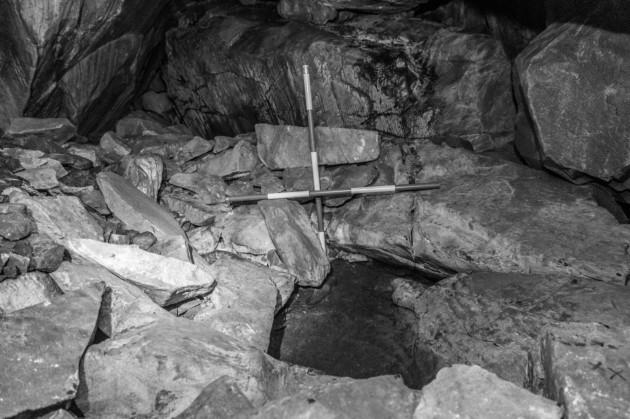
Ancient human remains found in Mayo date back over 5,000 years. Local hillwalker, Michael Chambers, came across the human bones in a rock-cut chamber among massive boulders in August 2016, while walking on Ben Gorm Mountain in the Nephin Beg range of west Mayo. The National Monuments Service, in consultation with the National Museum of Ireland, commissioned a rescue excavation, carried out by Dr Marion Dowd of IT Sligo.

Researchers concluded that the natural boulder chamber in which the remains were found was used for human burial practice during the Neolithic period. A least 10 individuals were placed in the chamber over a period of up to 1,200 years. One of the adult bones was dated to 3,600 BC, while a bone of a child skeleton dated to 2,400 BC.

Ben Gorm Mountain, Mayo
Image: T Kahlert via Department of Culture

Archaeologists believe that bodies were brought into the cave chamber and laid out in a pit. At some later stage, the skulls might have been deliberately broken as part of a complex burial ritual and the larger bones removed.

 “Large pieces of quartz had been placed in and around the bones. When the radiocarbon dates came through it was very exciting. Not only were the bones Neolithic, but the dates showed the site had been used for over 1,000 years,” Dr Dowd said.

Dr Dowd points out that it was not a burial site as such, but a ritual place where bodies were placed to decompose. Only a very small proportion of each skeleton was found, with most of the bones apparently deliberately removed.

 Pit in the cave which contained human remains after the excavation
Image: T Kahlert via Department of Culture

The Neolithic period was a time of change with a move from hunting and gathering to a more settled way of life associated with the beginnings of agriculture. Burial practices in this period entailed interment in large, highly visible monuments, and by ritual practices resulting in the scattering of human bones. These monuments were frequently built in the densely populated regions of the Mesolithic Period and may have been markers between the new and old peoples. They signified a lasting link between the community, the ancestral dead, and the land which they occupied.
It has been suggested that the shape of these ancient tombs is related to the type of housing favoured in an area (round, rectangular, trapezoid or irregular. Large communal monuments for the dead began to appear on the coastal fringes of Western Europe during this period.
More than 6,000 years ago, the Stone Age peoples of Western Europe began to build stone monuments over their dead as tombs and ceremonial places. This was the beginning of what has become known as the megalithic tradition of the Neolithic period.
The first small passage tombs on the summit of Knocknarea, Co. Sligo, were probably built in the first half of the fourth millennium BC, physically marking out the ritual significance of the place. A few hundred years later, the sacred space was defined by a complex system of banks along the eastern side of the mountain. The cairn known today as Miosgán Meadhbha (the legendary burial place of Queen Maeve) was probably built around this time and most likely covers a passage tomb.
High up on the north-western slopes of Knocknarea there are a number of natural caves, and in two of them human remains of Neolithic date have been found. These may have been places used for defleshing of the dead.  The caves might have played a role in the rituals linked to the monuments on the summit.
New insights into the funerary practices in ancient Ireland are being provided through studies led by a researcher at the Department of Anatomy at New Zealand's University of Otago.  The project applies modern techniques and research questions to human remains that were originally excavated more than 100 years ago. Researchers, lead author is Dr Jonny Geber, focuses on the 5000 years-old Passage Tomb Complex at Carrowkeel, also in County Sligo. This site is one of the most impressive Neolithic ritual landscapes in Europe.

Two of the tombs at Carrowkeel, Ireland. ( public domain )

             The team analysed bones from up to seven passage tombs that included both unburnt and cremated human remains from around 40 individuals. Dr Geber and his colleagues found that the unburnt bone displayed evidence of dismemberment.

"We found indications of cut marks caused by stone tools at the site of tendon and ligament attachments around the major joints, such as the shoulder, elbow, hip and ankle.”

According to Dr Geber, the new evidence suggest that a complex burial rite was undertaken at Carrowkeel, that involved a funerary rite that focussed on the "deconstruction" of the body.

"This appears to entail the bodies of the dead being 'processed' by their kin and community in various ways, including cremation and dismemberment. It was probably done with the goal to help the souls of the dead to reach the next stages of their existence."

This study shows that the Carrowkeel complex was probably a highly significant place in Neolithic society in Ireland, and one which allowed for interaction and a spiritual connection with the ancestors. The evidence suggests that the people of Neolithic Ireland may have shared similar beliefs and ideologies concerning the treatment of the dead with communities beyond the Irish Sea, according to the researchers, Dr Geber says.

Friday, December 29, 2017

The Scythians

Territory occupied by the Scythians
The exhibition entitled Scythians: warriors of ancient Siberia, at the British Museum in London, brought back memories for me of a people who lived around Lough Gara in the 5th Century. It is said that St. Patrick went to the Gregraidhe of Loch Techet, now known as Loch Gara. The Gregraidhe (‘horse people’) or Gregory, occupied the baronies of Coolavin in Sligo and Costello in Mayo. Perhaps, the Gregraidhe owed their prowess as horse people to the Scythians - just a thought?

Who were the Scythians
The Scythians were a group of ancient tribes of nomadic warriors who originally lived in what is now southern Siberia. Their culture thrived from around 900 BC to around 200 BC, by which time they had extended their influence all over Central Asia from China to the northern Black Sea.  These people did not leave any written record of their lives. According to accounts written by the Greeks, Assyrians and Persians, they were terrified but also impressed by the Scythians. The Greek historian Herodotus, wrote:
‘None who attacks them can escape, and none can catch them if they desire not to be found.’

In the New Testament, a letter ascribed to St. Paul refers to the Scythians:
‘Here there is no Greek or Jew. There is no difference between those who are circumcised and those who are not. There is no rude outsider, or even a Scythian. There is no slave or free person. But Christ is everything. And he is in everything.’ (Colossians 3:11)

Early modern English writers on Ireland often resorted to comparisons with Scythians to confirm that the native population of Ireland descended from these ancient people and showed themselves as barbaric as their alleged ancestors.
 As the Scythians were nomads, their personal possessions had to be portable and durable, generally light, and small or collapsible. As well as objects made of leather, cloth, felt and wood, professional metalworkers also manufactured tools, weapons, and small personal ornaments.

Highly skilled horsemen
The Scythians were the first of many waves of warriors on horses who swept westward over the vast Eurasian steppes, which extend from Mongolia more than four thousand miles to the Carpathian Mountains in Europe. They would be followed over the centuries by the Huns, the Magyars (who settled in Hungary), the Bulgars (who settled in Bulgaria), and the Mongols.
Scythian Warrior
They developed more efficient ways of riding horses which meant they could move bigger herds to new grazing grounds over larger distances. They were skilled riders and their horse gear (saddles, bridles, bits etc) was also highly developed and functional, durable, and light.
Their horses were buried with very elaborate costumes including headgear with griffins or antlers, saddle covers decorated with combat scenes, and long dangling pendants. As well as providing milk, meat and hide, horses were the main means of transport and the driving force behind the Scythians’ military strength.

Battle tactics and weaponry
The Scythians were among the earliest peoples to master mounted warfare. They kept herds of horses, cattle, and sheep, lived in tent-covered wagons, and fought with bows and arrows on horseback.
The Scythians battle tactics included using large numbers of highly mobile archers who could shower hundreds of deadly arrows on the enemies within a few minutes. Some classical writers state that the Scythians dipped their arrows in poison! When the Scythians fought on foot, their weapon of choice was a battle-axe with a long narrow pointed blade like a narrow pick-axe. The weapons’ tell-tale puncture marks have been found on the heads of excavated human remains.
Another writer wrote that:
‘The Scythians have no houses but live in wagons. These are very small with four wheels. Others with six wheels are covered with felt; such wagons are employed like houses, in twos or threes and provide shelter from rain and wind.’

The Scythians played a leading role in the destruction of the Assyrian Empire, including the destruction of Nineveh in 612 BC, which was at that time, the greatest city in the world.

Burial customs
In the high Altai mountain region near the borders of Russia, Kazakhstan, China and Mongolia, the frozen subsoil has meant that the organic remains of Scythians buried in tombs have been remarkably well preserved in permafrost. The Scythians preserved the appearance of the dead using a form of mummification. They removed the brain matter through holes cut in the head, sliced the bodies, and removed as much soft tissue as possible before replacing both with dry grass and sewing up the skin.
Log trunk coffin
When the Scythians buried their dead, they took care to equip the corpse with the necessities needed for the perpetual rides of the afterlife. They usually dug a deep hole and built a wooden structure at the bottom. Inside the tomb chamber, the body was placed in a log trunk coffin, accompanied by some of their prized possessions and other objects. Outside the tomb chamber but still inside the grave shaft, they placed slaughtered horses, facing east.

Skilled metalworkers
Excavations of burial mounds in Siberia have revealed a wealth of Scythian objects. Scythian craftsmen were good at casting metal and worked with gold, bronze, and iron, using a combination of techniques like casting, forging, and inlaying with other materials. Many beautiful examples of Scythian metalwork survive today.
Collapsible table. Mound 2, Pazyryk, Altai mountains, southern Siberia, late 4th–early 3rd century BC. © The State Hermitage Museum, St Petersburg, 2017. Photo: V Terebenin.
Collapsible tables were common finds in the Pazyryk tombs. They vary in height from 18–47cm but share the same feature of a tray-like oval top and four lathe-turned or hand-carved legs).
  
Gold plaque - 300 BC
This beautiful gold plaque was made by nomads in Siberia about 2,300 years ago. One half of a symmetrical belt buckle, it would certainly have belonged to Scythian nobility, perhaps royalty. Gold was associated with the sun and royal power.
The scene shows a deceased man, a female deity with a high ponytail (left), a tree of life in which a quiver hangs, and a man holding two horses’ reins. When a Scythian man wanted to marry, he hung his quiver before the woman’s wagon. The scene may refer to a symbolic marriage between the deceased and the ‘Great Mother’ – a giver of life who is also associated with underworld powers.

Leisure time
Herodotus also describes how the Scythians had a ritual which involved getting high on hemp in a kind of mobile ‘weed sauna’:
‘They anoint and wash their heads; as for their bodies, they set up three poles leaning together to a point and cover these over with woollen mats; then, in the place so enclosed to the best of their power, they make a pit in the centre beneath the poles and the mats and throw red-hot stones into it… The Scythians then take the seed of this hemp and, creeping under the mats, they throw it on the red-hot stones; and, being so thrown, it smoulders and sends forth so much steam that no Greek vapour-bath could surpass it. The Scythians howl in their joy at the vapour-bath. This serves them instead of bathing, for they never wash their bodies with water.

Reading Herodotus’s description of this ritual, involving a pit and hot stones, I wonder if, perhaps, the early Irish used their fulacht fiadh for a similar purpose?
Many of the customs of the Scythians struck the Greeks as bizarre. For example, Herodotus reports that the Scythians drank their wine neat, that is, undiluted with water, contrary to the custom among the Greeks, who diluted their wine with water. The Scythians had a reputation for drinking to excess and getting high. Like the ancient Irish, feasting was an important part of Scythian funeral ceremonies and helped social bonding between individuals and tribes.

The BP exhibition Scythians: warriors of ancient Siberia is on at the British Museum from 14 September 2017 to 14 January 2018. 

For further information see:

Friday, December 22, 2017

Ötzi the Iceman

Ötzi the Iceman
Occasionally, a chance discovery brings us literally face to face with our ancient past. Bog bodies, which are usually well preserved, are one example of such finds. Perhaps, the best-known discovery of a mummified body in Europe is ‘Ötzi’ the Iceman.
About 5,300 years ago, Ã–tzi was shot with an arrow, struck on the head, and left to die near a mountain pass high in the Alps. In 1991, hikers near the Italian-Austrian border discovered his body in a glacier. Ötzi is the oldest mummy in Europe. What can he tell us about our Neolithic ancestors: how they lived, the tools and weapons they used, and the clothing they wore?

Where he came from
The research confirmed that modern Sardinians are Ötzi's closest relatives. However, he most closely resembled prehistoric farmers found in Bulgaria and Sweden. Ötzi was a native of Central Europe and not a first-generation émigré from Sardinia, according to new research.
The new findings support the theory that farmers, and not just the technology of farming, spread during prehistoric times from the Middle East all the way to Finland.

Where he grew up
Ötzi wasn't far from home when he died. Scientists concluded that he didn't live in the Alps as such, but spent most of his life in Isack Valley or the lower Puster Valley, in the northernmost part of what is now Italy. He probably spent the last 10 years of his life in an area south and west of his previous home, not far from where he died.
Contact between people who lived south and north of the Alps at this time was thought to have been limited. However, people who travelled in the Alps had a very deep knowledge of the landscape and its conditions due to their experience with hunting, herding, and exploring natural resources in these areas. It is thought likely that Ötzi traded furs or domestic animals.

His equipment
The Neolithic herdsman carried several pieces of equipment when he died, including numerous wooden tools that were used to make clothing or utensils. Among the equipment he carried was an axe of almost pure copper thought to have been a status symbol, indicating that he ranked high in his pastoralist culture. Its wooden handle and leather straps were still preserved. Ötzi was also carrying a bow and arrow, which he had leaned against a tree before he died.
Copper Axe found with Ötzi's Body
Researchers have now traced the source of the metal in Ötzi’s axe to southern Tuscany. It had been thought that people living around the Alps at that time got their copper locally or from the Balkans.

Another copper axe
Archaeologists have found a copper blade in Switzerland resembling the axe Ötzi was carrying when he died. It was made from copper that also came from Tuscany. The axe was discovered in Zug-Riedmatt, one of the many pile-dwelling villages around the Alps famous for their prehistoric wooden houses built on stilts on lakeshores and other wetlands. This new axe was between 5,300 and 5,100 years old and missing its wooden handle. 

Clothing
Most of Ötzi's clothing was badly disintegrated, but researchers did manage to retrieve parts of his sheep and cow leather shoes, goatskin leggings, bear fur cap, and animal skin loincloth. The iceman also carried a grass mat or cape with him, either to sleep on or shield him from the rain.
Some of the Clothing Worn by Ötzi the Iceman
Ötzi wore garments made from the skins of different animals. His leather overcoat was made from at least four different individual animals from two species of sheep and goat while his lighter coat was made of sheep. His leather shoes were stuffed with grass, with shoelaces made from wild cow or auroch (an extinct species of large wild cattle that inhabited Europe, Asia, and North Africa. It is the ancestor of domestic cattle).  His furry hat was made from brown bear while his quiver was made from a roe deer.

His health
Scientists found that the Iceman had tooth decay, ate an agricultural diet, and had Lyme disease. The oldest red blood cells ever identified have been found in his body. Ötzi suffered from heart disease and joint pain before he died. Analysis of his skeleton revealed he had bad knees and was lactose intolerant.

His relatives
Scientists sequenced Ötzi's entire genome and compared it with those from hundreds of modern-day Europeans, as well as the genomes of a Stone Age hunter-gatherer found in Sweden, a farmer from Sweden, a 7,000-year-old hunter-gatherer iceman found in Iberia, and an Iron Age man found in Bulgaria. Researchers have established from genetic analysis that Ötzi has living relatives in the region.
Ötzi and his present-day relatives share a common ancestor, who may have lived 10,000 to 12,000 years ago. His mother's family appears to have originated in the Alps and did not spread from there.  Researchers concluded that Ó¦tzi's maternal line appears to have died out as the genetic lineage does not exist in modern populations alive today.

Probable cause of death
Scientists estimate that Ötzi was 45 years of age when he met his violent death in the mountains. His last meal included red deer meat with herb bread. The probable cause of his death was an arrow wound to the shoulder that sliced an artery.
The fact that he had an undigested meal in his stomach suggests the Iceman was ambushed, but scientists couldn't agree whether he was bashed over the head or killed by an arrow that nicked an artery in his shoulder. In a 2012 study, scientists analysed the mummy's red blood cells and concluded that Ã–tzi bled to death after the arrow wound.

Ötzi today
Ötzi's perfectly preserved body is stored in a specially designed cold storage chamber at the South Tyrol Museum of Archaeology in Italy at a constant temperature of -6°C (21°F).

For further information see:


Friday, December 15, 2017

It’s all in the Genes


My mother’s people came from somewhere in the Sahara Desert. They were nomads who lived around 16,500 years ago, moving from place to place, carrying all their possessions with them. My DNA test results have helped to throw some light on my ancestors, and perhaps yours, and the journey they made to reach the West of Ireland
Ireland's remote geographical position has meant that the Irish gene-pool has been less susceptible to change, and the same genes have been passed down from parents to children for thousands of years. Research into both British and Irish DNA indicate the people of both islands have much in common genetically. The closest genetic relatives of the Irish in Europe are to be found in the north of Spain in what is now known as the Basque Country. We share this common ancestry with the people of Britain and with the people of Scotland.

The following quote comes from the general preamble to my results.

 “It is important to consider, understand and perhaps deeply appreciate the fact that the very concept of race is man made. We live on one planet. Borders and modern day political countries are purely created by man and do not resemble genetics.
There is no such thing as a French, British or German person, as, in fact, people, from what is today called Germany, and people, from what is today called Syria, are more closely related genetically than two people from Uganda living in adjoining villages.
Genetic blueprints are very much shaped by:
Immigration – Warfare – Migration – Intermarriage – Conquest – Choices
Therefore, our DNA is a unique combination of genetic markers that are found all over the world.
We are all made up of all of us.”

Quote from ‘The story of your ancestry as never told before’

William Murphy
Famine (1997) on the Custom House Quay in Dublin
Photo; Flickr

 
The test looked at three areas of my genetic code: Fatherline (Y-DNA) History, Motherline (mtDNA) History and Family Ancestry (autosomal DNA) and the results are summarised in the table below. The test results provide a genetic code or a ‘genetic signature’ which is then compared with various populations providing a percentage frequency by geographic area. We can then see where people with our code originated and migrated.

Summary of my DNA test results


Fatherline (Y-DNA) History

Motherline (mtDNA) History

Haplogroup: R-M222
Haplogroup: H1
Subclade: R-DF109

A predominantly Irish branch of the R-L21 fatherline.

Haplogroup H is predominantly European, originating around 16,500 years ago.

My fatherline signature belongs to the R-M222 group.

H1 is found as far as Africa, Central Asia, and Siberia
Ireland – 25%
Scotland – 10%
England – 10%
Wales – 5%

Norway, Sweden, France, and Orkney Islands – 1% each

Populations from southwest France, Sardinia and the Iberian Peninsula show the highest levels of H1 within Europe

Tuareg (Fezzan) – 61%
Basque – 27%
Portugal – 25%
Ireland – 16%
United Kingdom – 16%

Ireland – 25%
Scotland – 10%
England – 10%
Wales – 5%

Norway, Sweden, France, and Orkney Islands – 1% each


Fatherline (Y-DNA) History

The Y chromosome (YDNA) is passed down from father to son, which is referred to as the ‘fatherline’. It is the sex chromosome that determines you are male. So only sons inherit the Y chromosome from their father.
The haplogroup is a collection of related family lines we are connected to through the Y chromosome (YDNA). Apparently, I share a common ancient ancestor with all the people who share my haplogroup. Haplogroups can be associated with geographic regions, and are also used to trace the ancient migrations of early humans.

R-M222 is a branch of the larger R-L21 fatherline, which is itself a branch of the much larger R1b fatherline which was carried by waves of Indo-European expansions, and which is very common throughout Western Europe. R-L21 is associated with the northern Atlantic shores of Europe today, especially in parts of Britain and Brittany. The R-M222 branch of this fatherline is most frequently found in Ireland.
Subclade R-DF109 is a predominantly Irish branch of the R-L21 fatherline and examples of its distribution in modern society include: Ireland (25%), Scotland (10%), England (10%) and Wales (5%).

Motherline (mtDNA) History

Haplogroup: H1
Haplogroup H is predominantly European, originating around 16,500 years ago. Apparently, my motherline signature belongs to the H1 group. It has been suggested that the carriers of haplogroup H were involved in the recolonisation of Europe from the Ice Age refuge locations. Examples of the distribution of H1 in present-day society are: Tuareg (61%), (The Tuareg people inhabit the Sahara Desert, in a vast area stretching from far southwestern Libya to southern Algeria, Niger, Mali and Burkina Faso.), Basque (27%), Portugal (25%), Ireland (16%) and United Kingdom (16%).

Family Ancestry (autosomal DNA)

Family ancestry (autosomal DNA) – looks at ancestry over approximately 5-6 generations

Great Britain and Ireland 95.8%
Europe (North and West) 2.6%
Europe (South) 1.7%

Great Britain and Ireland – 95.8%
Southwest Scotland and Northern Ireland – 36.6%
Ireland – 20.9%
East Anglia – 13.4%
Europe (North and West) – 2.6%
Scandinavia – 2.6%
Europe (South) – 1.7%
Basque – 1.7%

Family ancestry (autosomal DNA)

Autosomal DNA is passed down from all our ancestors and the combination makes up our genetic code. A typical code provides the genetic history going back approximately 10 generations. This gives a percentage estimate against the population groups that my genetic code is compared against. For example: Great Britain and Ireland (95.8%), Southwest Scotland and Northern Ireland (36.6%) and Ireland (20.9%).

Great Britain and Ireland: Ireland

Ireland was unaffected by the Romans and Anglo Saxons who invaded and settled in neighbouring Britain but did feel the undesired impact of the Vikings from Scandinavia. The genetic influence of the Viking invasion may be much smaller than the considerable cultural influences that resulted from the settlements and raids of the Vikings from 795 AD.
Researchers can still detect the DNA of Nomadic Stone Age people that first settled Britain at the end of the last ice age – the same signature that can be found in western Germany, north western France, and Belgium today. The population of Wales is thought to be the most closely related to the earliest, most ancient settlers who migrated over after the last ice age. Not only is Wales genetically unique but North Wales is even genetically different from the south.

Modern Humans - Migration

Scientists believe that Modern humans (Homo sapiens) first appeared around 200,000 years ago in what is now known as Africa. However, a re-evaluation of early human remains and artefacts from Morocco has suggested that the advent of Homo sapiens may have to be put back by 100,000 years. Archaeologists and palaeontologists believe that the oldest of the fossils comes from 300,000 to 350,000 years ago.
Current scientific understanding shows us that no modern humans ventured outside Africa before c.120,000 years ago. The first large scale migration out of Africa happened around 65,000 years ago. Humans reached India, Australia, and New Guinea 50,000 years ago. This was followed by a wave of migration into the Middle East and then into Europe c. 45,000 years ago. Finally, migration into the Americas took place within the last 15,000 years.

Migration Map
Wikipedia

             The direct maternal and paternal lines of all individuals living today come together in single groups of people from around 200,000 years ago.

Genetic diversity out of Africa

 Two individuals from neighbouring villages in Uganda can have greater genetic difference than two individuals living in the areas now known as Europe, India, or Asia. This shows how genetic diversity is very limited in modern human beings outside of Africa.

Our changing genes

Every movement of human beings has produced different challenges. The environment and the way that humans lived meant that the genetic code of different branches of human beings mutated. Within a population group those individuals with a certain mutation may have greater survival rates than those without. Those without the mutation would die at a faster rate and therefore the mutated gene spreads.
Researchers tell us that the reason many Africans are naturally resistant to malaria is because 33,000 years ago the genetic structure of the African population group changed (mutated). Because Europeans had already migrated out of Africa, they did not carry this mutation and therefore many are not resistant to malaria.
DNA is a powerful tool which is increasing understanding of our ancient ancestors, where they came from, how they lived, and the journeys they made over many thousands of years. My mother was born and died in the same house in Co. Roscommon, and the Sahara Desert was a distant place. She did, however, recall carrying farmyard manure on her back as a child to fertilise the land - like her ancient ancestors who carried their possession across the desert sands.

For further information you may wish to view the following YouTube videos: