Showing posts with label Gregraidhe. Show all posts

Monday, March 17, 2025

St. Patrick - Ireland's Patron Saint


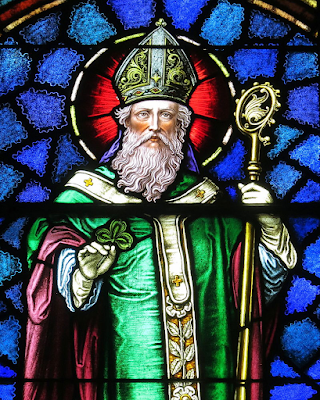
Stained glass image of St. Patrick. Photo: Wikipedia

Place of Birth

Much controversy surrounds the details of St. Patrick's life. He is believed to have been British by birth, the son of a decurio or town councillor. His place of birth is said to have been somewhere in the west between the mouth of the Severn and the Clyde. He was born sometime between 385 and 389. Patrick himself tells us he was of Romano-British origin. The names of his parents were Calpurnius and Concessa.

Captured Slave

While still a youth he was captured by Irish pirates and reduced to slavery. For six years he herded swine or sheep in Co. Antrim or on the coast of Co. Mayo. During the period of Patrick's captivity in Ireland he learned the native language and got to know the pagan practices of the Druid priests.

Escape

St. Patrick eventually escaped and returned to his family. However, he was constantly troubled by visions of the pagan Irish imploring him to walk among them once more.

Ordained Bishop

Patrick was later ordained a bishop and in the year 432 AD he returned to Ireland. He knew very well that if he was to succeed in Ireland then he must first convert the kings and chieftains. Otherwise, the people would not be allowed to worship in peace. He faced many dangers including assassination, the military might of kings, and opposition of the powerful druids whose very existence he threatened.

First Church

It was the Chieftain Dichu who gave Patrick a plot of land on which to build his first church in Co. Down. St. Patrick spent many years in Ireland although exactly how long we do not know. During this time, he travelled extensively. He writes:

“I journeyed among you, and everywhere, for your sake, often in danger, even to the outermost parts beyond which there is nothing, places where no one had ever arrived to baptise or ordain clergy or confirm the people.”

Celtic Religion and Art

Ireland, in those days, was quite different from Britain in many ways: it had its own language, political structures, customs and laws. It had not been invaded by Roman legions. It was also located at the furthest reaches of the known world.

Decorated Grave Slab from Carrowntemple, Co. Sligo (Replica)

We can also see the merging of pagan and Christian art as Christianity gradually replaced paganism. Two of the grave slabs at Carrowntemple, Co. Sligo, bear art of the Early Christian period that is derived from the Celtic art of the preceding Pagan Iron Age. One of these is close to a design in the Book of Durrow and is datable to c. 650 AD. Several of the panels of the seventh century Moylough Belt-shrine, found only a few miles west of Carrowntemple, have this same mix of Pagan and Christian artwork.

Early Irish texts suggest that holy wells may have remained associated with non-Christian rituals and were even protected by the old religion. For example, it is believed that wells were used instead of baptisteries in Ireland, which may explain the substantial number of holy wells throughout the country.

In some respects, the nature of the Celtic religion helped in the development of Christianity. Their belief in the indestructibility of the souls of the dead helped in understanding the resurrection of Christ. The Celts also had their own sacrifices and ritual meals which, in a sense, mirrored aspects of Christian message.

Lough Gara formerly known as Loch Techet

Patrick Travels to the West

We know from ecclesiastical history that he travelled to the west of Ireland. After visiting Elphin and Croghan, he came around the north of Loch Techet, the ancient name for Lough Gara, through the present townlands of Cuppenagh and Templeronan. It is said that he went to Gregraidhe of Loch Techet. The Gregraidhe (horse people) or Gregory comprised the baronies of Coolavin in Sligo and Costello in Mayo. According to an entry in the Annals of Tigernach (AU 665) Cummeni, Abbot of Clonmacnoise, was of the Gregraige of Loch Techet.

When the tribe responded to the Gospel, an enclosure would be set aside, with boundaries and ‘termon’ crosses, sometimes with a ditch, sometimes with a wall, clearly marking out to everyone that the area was sacred. Within it a tiny church of wattle and daub would be built.

Monasteries

Many monasteries were built at tribal meeting places or on tribal boundaries. As monastic communities grew, they attracted a resident local community. The monasteries provided for the spiritual needs of local families and taught the children. The monastery and the village grew together. Monks undertook tasks such as the creating and copying of literature and highly specialised metalware.

According to Tirechan, the Bishop of North Mayo, Patrick came from the plain of Mirteach, between Castlerea and Ballaghaderreen, to a place called Drummut Cerrigi or Drumad of the Ciarraige. This is now the townland of Drumad in the Parish of Tibohine. It is said that he dug a well here and no stream went into it or came out of it, but it was always full. The well was named Bithlan (i.e. ever full).

Here, the saint found two brothers, Bibar and Lochru, the sons of Tamanchend, fighting about the division of their father's lands. St. Patrick reconciled them by a miracle, and he blessed them and made peace between them. The brothers gave their land to Patrick, and he founded a church there.

Patrick then went to Aileach Esrachta which was at Telach Liac or Telach na Cloch, which later became known as Tullaganrock in the Parish of Kilcolman. It is said that local people were afraid of the stranger and the eight or nine men accompanying him, so they decided to kill him. The crowd was restrained by a brave man named Hercait of the race of Nathi. Hercait and his son Feradach were babtised and Feradach joined St Patrick. Patrick gave Feradach a new name calling him Sachail. He eventually became bishop and was associated with a famous church called Basilica Sanctorum which is now known as Baslik - a parish between Castlerea and Tulsk.

Croagh Patrick, Co. Mayo. Photo: Wikipedia
Forty Days and Nights

Patrick spent forty days and nights fasting on the top of Croagh Patrick, Co. Mayo. Archaeologists have discovered the remains of a church/oratory dating from the early Christian period on the top of this mountain. The entire summit was enclosed by a stone wall which may have been the enclosing wall of an early monastic site.

Death

We are told that when the shadow of death came near, Patrick returned to the first church he had built at Soul, Co. Down and died on March 17th, 461. There is, however, some uncertainty as to the actual year of his death.

Legend has it that St. Patrick expelled snakes from Ireland, explained the Trinity using the shamrock, and accomplished single-handed great missionary tasks of conversion. Scholars doubt if there were ever snakes in Ireland.

St. Patrick remains the most popular of Irish saints. In art, he is usually depicted wearing the vestments of bishop treading on snakes. In the National Museum of Ireland shrines survive of his bell and his tooth (12th & 14th century). His fame has spread throughout the world, and we celebrate his feast day on 17th March.

https://www.youtube.com/watch?v=DIphXep4nSQ


Friday, December 29, 2017

The Scythians

Territory occupied by the Scythians
The exhibition entitled Scythians: warriors of ancient Siberia, at the British Museum in London, brought back memories for me of a people who lived around Lough Gara in the 5th Century. It is said that St. Patrick went to the Gregraidhe of Loch Techet, now known as Loch Gara. The Gregraidhe (‘horse people’) or Gregory, occupied the baronies of Coolavin in Sligo and Costello in Mayo. Perhaps, the Gregraidhe owed their prowess as horse people to the Scythians - just a thought?

Who were the Scythians
The Scythians were a group of ancient tribes of nomadic warriors who originally lived in what is now southern Siberia. Their culture thrived from around 900 BC to around 200 BC, by which time they had extended their influence all over Central Asia from China to the northern Black Sea.  These people did not leave any written record of their lives. According to accounts written by the Greeks, Assyrians and Persians, they were terrified but also impressed by the Scythians. The Greek historian Herodotus, wrote:
‘None who attacks them can escape, and none can catch them if they desire not to be found.’

In the New Testament, a letter ascribed to St. Paul refers to the Scythians:
‘Here there is no Greek or Jew. There is no difference between those who are circumcised and those who are not. There is no rude outsider, or even a Scythian. There is no slave or free person. But Christ is everything. And he is in everything.’ (Colossians 3:11)

Early modern English writers on Ireland often resorted to comparisons with Scythians to confirm that the native population of Ireland descended from these ancient people and showed themselves as barbaric as their alleged ancestors.
 As the Scythians were nomads, their personal possessions had to be portable and durable, generally light, and small or collapsible. As well as objects made of leather, cloth, felt and wood, professional metalworkers also manufactured tools, weapons, and small personal ornaments.

Highly skilled horsemen
The Scythians were the first of many waves of warriors on horses who swept westward over the vast Eurasian steppes, which extend from Mongolia more than four thousand miles to the Carpathian Mountains in Europe. They would be followed over the centuries by the Huns, the Magyars (who settled in Hungary), the Bulgars (who settled in Bulgaria), and the Mongols.
Scythian Warrior
They developed more efficient ways of riding horses which meant they could move bigger herds to new grazing grounds over larger distances. They were skilled riders and their horse gear (saddles, bridles, bits etc) was also highly developed and functional, durable, and light.
Their horses were buried with very elaborate costumes including headgear with griffins or antlers, saddle covers decorated with combat scenes, and long dangling pendants. As well as providing milk, meat and hide, horses were the main means of transport and the driving force behind the Scythians’ military strength.

Battle tactics and weaponry
The Scythians were among the earliest peoples to master mounted warfare. They kept herds of horses, cattle, and sheep, lived in tent-covered wagons, and fought with bows and arrows on horseback.
The Scythians battle tactics included using large numbers of highly mobile archers who could shower hundreds of deadly arrows on the enemies within a few minutes. Some classical writers state that the Scythians dipped their arrows in poison! When the Scythians fought on foot, their weapon of choice was a battle-axe with a long narrow pointed blade like a narrow pick-axe. The weapons’ tell-tale puncture marks have been found on the heads of excavated human remains.
Another writer wrote that:
‘The Scythians have no houses but live in wagons. These are very small with four wheels. Others with six wheels are covered with felt; such wagons are employed like houses, in twos or threes and provide shelter from rain and wind.’

The Scythians played a leading role in the destruction of the Assyrian Empire, including the destruction of Nineveh in 612 BC, which was at that time, the greatest city in the world.

Burial customs
In the high Altai mountain region near the borders of Russia, Kazakhstan, China and Mongolia, the frozen subsoil has meant that the organic remains of Scythians buried in tombs have been remarkably well preserved in permafrost. The Scythians preserved the appearance of the dead using a form of mummification. They removed the brain matter through holes cut in the head, sliced the bodies, and removed as much soft tissue as possible before replacing both with dry grass and sewing up the skin.
Log trunk coffin
When the Scythians buried their dead, they took care to equip the corpse with the necessities needed for the perpetual rides of the afterlife. They usually dug a deep hole and built a wooden structure at the bottom. Inside the tomb chamber, the body was placed in a log trunk coffin, accompanied by some of their prized possessions and other objects. Outside the tomb chamber but still inside the grave shaft, they placed slaughtered horses, facing east.

Skilled metalworkers
Excavations of burial mounds in Siberia have revealed a wealth of Scythian objects. Scythian craftsmen were good at casting metal and worked with gold, bronze, and iron, using a combination of techniques like casting, forging, and inlaying with other materials. Many beautiful examples of Scythian metalwork survive today.
Collapsible table. Mound 2, Pazyryk, Altai mountains, southern Siberia, late 4th–early 3rd century BC. © The State Hermitage Museum, St Petersburg, 2017. Photo: V Terebenin.
Collapsible tables were common finds in the Pazyryk tombs. They vary in height from 18–47cm but share the same feature of a tray-like oval top and four lathe-turned or hand-carved legs).
  
Gold plaque - 300 BC
This beautiful gold plaque was made by nomads in Siberia about 2,300 years ago. One half of a symmetrical belt buckle, it would certainly have belonged to Scythian nobility, perhaps royalty. Gold was associated with the sun and royal power.
The scene shows a deceased man, a female deity with a high ponytail (left), a tree of life in which a quiver hangs, and a man holding two horses’ reins. When a Scythian man wanted to marry, he hung his quiver before the woman’s wagon. The scene may refer to a symbolic marriage between the deceased and the ‘Great Mother’ – a giver of life who is also associated with underworld powers.

Leisure time
Herodotus also describes how the Scythians had a ritual which involved getting high on hemp in a kind of mobile ‘weed sauna’:
‘They anoint and wash their heads; as for their bodies, they set up three poles leaning together to a point and cover these over with woollen mats; then, in the place so enclosed to the best of their power, they make a pit in the centre beneath the poles and the mats and throw red-hot stones into it… The Scythians then take the seed of this hemp and, creeping under the mats, they throw it on the red-hot stones; and, being so thrown, it smoulders and sends forth so much steam that no Greek vapour-bath could surpass it. The Scythians howl in their joy at the vapour-bath. This serves them instead of bathing, for they never wash their bodies with water.

Reading Herodotus’s description of this ritual, involving a pit and hot stones, I wonder if, perhaps, the early Irish used their fulacht fiadh for a similar purpose?
Many of the customs of the Scythians struck the Greeks as bizarre. For example, Herodotus reports that the Scythians drank their wine neat, that is, undiluted with water, contrary to the custom among the Greeks, who diluted their wine with water. The Scythians had a reputation for drinking to excess and getting high. Like the ancient Irish, feasting was an important part of Scythian funeral ceremonies and helped social bonding between individuals and tribes.

The BP exhibition Scythians: warriors of ancient Siberia is on at the British Museum from 14 September 2017 to 14 January 2018. 

For further information see: