Showing posts with label megalithic. Show all posts

Saturday, May 2, 2015

Silence in Court - Creevykeel Court Tomb


Creevykeel Court Tomb - County Sligo
Hidden behind a tall hedge on the busy Sligo to Bundoran road lies the Creevykeel Court Tomb. There, the casual visitor will find what looks like a low elongated pile of stones of varying sizes some of which have been deliberately positioned. However, there is much more to this ancient site than meets the eye.
More than 6,000 years ago, the Neolithic or New Stone Age peoples of Western Europe began to build stone monuments over their dead as tombs and ceremonial places. This was the beginning of what has become known as the megalithic tradition of the Neolithic period.
Creevykeel Court Tomb is amongst the finest examples of its type in Ireland. It dates from the Neolithic Period, 4000-2500 BC and was excavated in 1935 and then restored. The monument is located on the foothills of Tievebaun Mountain close to the sea near Mullaghmore in County Sligo. The old name for Creevykeel is Caiseal a' Bhaoisgin, the Fort of Bhaoisgin, Bhaoisgin being the well near the cairn.
The cairn measures 55 x 25 meters, with the wide edge to the east and tapers away to a tail at the west end. The actual court itself, which is enclosed by the cairn, is oval in shape measuring 15 x 9 meters. It is lined with large boulders that rest on the surface rather than sunk into the ground. The main body of the cairn was originally surrounded by a stone revetment to hold the mound together.
A narrow entrance passage, lined with large boulders and approximately 4.5 m in length, leads from the east end to the court. There is a two-chambered gallery to the north west of the court. Three smaller chambers can be seen at the western end of the monument, two on the north side and one on the south side. These are quite different to the main chamber, and are considered by some archaeologists to be small passage graves.
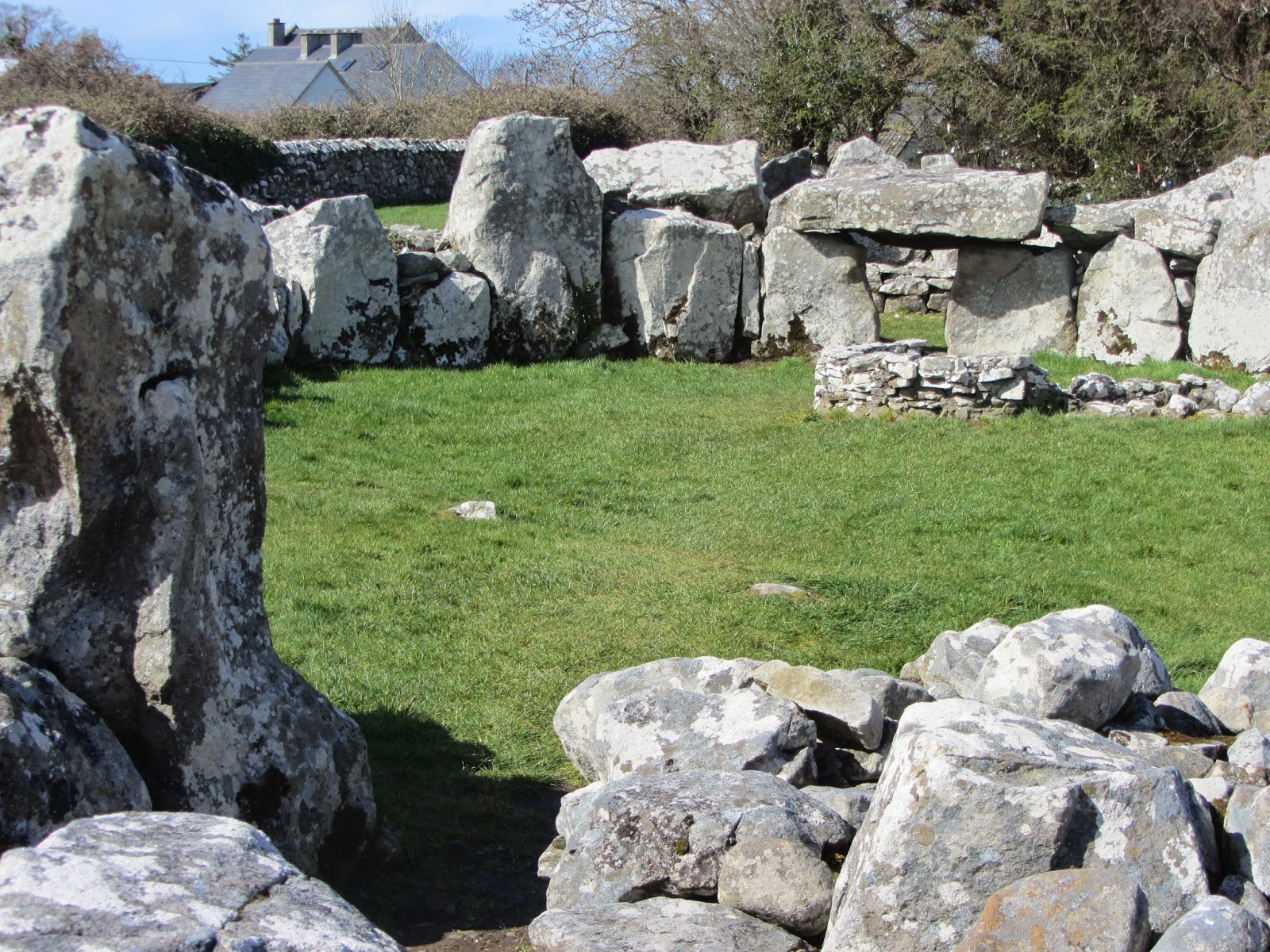
Court with Christian Feature top right
Large areas of the court were paved with small flat slabs while in places, cobble stones and sea sand from the nearby shore was also found. Archaeologists found evidence of large fires within this enclosed area as well as fragments of cremated bone and charcoal. The standing stones (orthostats) around the court are quite massive chunks of local sandstone. They get larger approaching the opening at the rear of the court, which gives access to an inner chamber, now roofless but which was originally covered with massive corbels, making an artificial cave.
It is unclear whether the eastern end was originally the higher as well as the broader, as is generally the case with these monuments. However, the excavation showed that the builders had used the natural slope of the ground to obtain the effect of height at this end.
Court-tombs date from the Neolithic Period and are found mainly in the northern half of the country. Most of these sites are to be found north of a line extending from Dundalk to Galway. Their most distinctive feature is the ceremonial court which is set in front of a gallery or galleries divided into two or more burial chambers.
The court usually occupies one end of a long cairn but sometimes there are courts and chambers at both ends of the cairn. In other examples, as in the case of Creevykeel, the court is completely enclosed within the cairn and is of circular or oval shape, access being gained through a short narrow passage leading to the front of the cairn.
These megalithic monuments usually had two functions: the chamber to serve as a tomb, and the courtyard to accommodate some form of ritual. Objects were often buried with the deceased, as the first Neolithic farmers believed in life after death.
Excavations at Creevykeel uncovered four cremation burials, decorated and undecorated Neolithic pottery, flint arrow heads, polished stone axes, a flint knife, stone bead, four blue glass beads, a small bronze broach and stud, part of a red deer antler handle, part of a comb and other artefacts, including a clay ball.
Over 133 stone axes alone have been discovered along the shores of Lough Gara. Stone axes are normally ascribed to both the Mesolithic and the Neolithic periods. Polished stone axes, however, seem to appear first in the Neolithic while ground axes can belong to the Mesolithic or Middle Stone Age. These tools were used for cutting, shaping and dressing wood. A small polished stone axe was also found during excavation of the Drumanone Portal Tomb close to Lough Gara.
Kiln from Early Christian Period
Inside the court area archaeologists discovered a kiln dating from the Christian Period together with evidence of iron-smelting. Iron Age and early Christian metalworkers seem to have liked working in ancient sites including crannogs. Such ancient sites may, perhaps, have held magical properties in relation to metalwork.
Archaeologists excavating a crannog at Lough Gara in the townland of Sroove found a small bowl-shaped depression that may represent the shape of a small bowl-furnace for iron-smelting. Nearby, was found remains of slag, some pieces of which had the red clay remains of the furnace attached to them. 
Creevykeel Court Tomb remains one of the best examples of its type in Ireland and is well worth a visit if you happen to be in that part of North Sligo which has a rich megalithic tradition.

Wednesday, June 12, 2013

Carrowmore Megalithic Cemetery, Co. Sligo


Carrowmore Megalithic Cemetery - Tomb 51
Today, Ireland is experiencing unprecedented austerity measures, farmers are unable to feed their cattle and fish stocks are depleted. However, the situation was not always so dire. Over 7,000 years ago, the rich marine resources around our shores enabled our ancestors to develop a more settled way of life even as hunter-gatherers and to, eventually, become some of Western Europe’s first farmers.

More than 6,000 years ago, the Stone Age peoples of Western Europe began to build stone monuments over their dead as tombs and ceremonial places. This was the beginning of what has become known as the megalithic tradition of the Neolithic period. The reason for this cultural change in Neolithic Europe was largely unknown for many years.

Carrowmore, Co. Sligo, is the largest cemetery of megalithic tombs in Ireland and is also among the country’s oldest, with dates ranging between 4,500 – 3,500 BC. Archaeologists have recorded over sixty tombs of which some thirty are visible today. The oldest tombs at Carrowmore were built more than 2,000 years before the pyramids of Egypt. The idea of erecting megalithic tombs developed within Stone Age societies of Western Europe in the fifth millennium BC during the transition between the Mesolithic and Neolithic periods.

Archaeologists believe that originally there may have been a 100 and, possibly, more tombs in the Carrowmore cemetery. However, over the past 300 years, quarrying and land clearance have destroyed many of them. In his survey of the area in 1837, George Petrie marked and numbered 68 sites at Carrowmore.

Carrowmore megalithic cemetery covers an area of about one square kilometre.  Most of the tombs have been arranged in an oval-shaped layout and the entrances tend to face the central part of the cemetery. The meaning and function of these early stone monuments remain one of the mysteries of archaeology. It is known that the Megalithic tradition died out about 5,000 years ago when it was at its peak. Well known monuments such as Stonehenge, Newgrange, Knowth and Dowth, were all built around this time.

There are some 1,500 recorded Megalithic monuments in Ireland. These ancient monuments have been classified into four types: court tombs, portal tombs, passage tombs and wedge tombs. Cremation was the most common way of disposing of the dead in passage tombs. Inhumation was mainly used in the case of portal tombs.

No passage tombs have been recorded at Carrowmore and only Tomb 51, which is also known as Listoghil, shows the remains of a cairn. This tomb stands at the highest point of the Carrowmore cemetery. It is 34m in diameter making it the largest tomb in the Carrowmore complex. It was partly excavated in the 1990s by the Swedish archaeologist Goran Burenhult.

Tomb 51 - Central Chamber
The central chamber was constructed as a rectangular cist or chamber and covered with a flat, limestone roof-slab. In 1993, prehistoric artwork was discovered on the front of the roof-slab.

During the building of this tomb, ritual activities took place involving extensive fires and these have been dated to 3,650 – 3,450 BC. A number of pits had also been dug during these ritual activities. Two cremations containing the remains of several humans were deposited in the circle behind the southern and western kerbstones and these were dated to 3,550 BC. The recovery of a piece of human skull dated to 3,500 BC shows that inhumations took place within the building period.

Excavation of Tomb No. 4 revealed 32 kilos of cremated human bone which had been deposited in the
Tomb 4
central chamber and in two secondary cists. It is believed that this amount of bone fragments represents as many as 50 individuals. The main grave goods recovered from this tomb were mushroom-headed antler pins which had been burnt together with the dead bodies on the funeral pyre. The secondary cists also contained stone beads.

Typical artefacts from the Carrowmore megalithic cemetery consist of mushroom-headed antler pins, stone/clay balls, beads and pendants. Archaeologists believe that the earliest monuments were built by people who were mainly hunter-gatherers but were turning to cattle breeding. The rich marine resources in this area made it possible for people to settle down on the peninsula and develop a relatively stable settlement pattern as hunter-gatherers, probably as early as 8,000 – 9,000 years ago (7,000 – 6,000 BC). Fishing, hunting for seal and other mammals, and the gathering of shellfish contributed to the development of a social structure normally found among farmers.

The tombs in the Carrowmore complex may have been signs of prestige in this ancient society or may have marked the tribe’s ceremonial and burial place. Each tomb probably belonged to a separate clan or extended family. With the passing of time, the settled pattern of life, together with the growing population, required a more active system of food production and farming was born.

The earliest dates from the excavated tombs at Carrowmore centre around 5,000 BC with the latest about 3,000 BC. Archaeologists believe that most of the monuments were erected and used between 4,300 and 3,500 BC. All of the tombs had been used for secondary burials during the late Neolithic, Bronze and Iron Ages.

The dates from Carrowmore confirm what is known about the development of the megalithic traditions in Brittany and France, where very early megalithic activity can be associated with late Mesolithic and early Neolithic societies forming complex social systems based on a rich maritime economy.

Based on ‘The Megalithic Cemetery of Carrowmore, Co. Sligo’ – Goran Burenhult (2001)