 |
| Creevykeel Court Tomb - County Sligo |
Hidden behind a tall hedge on the
busy Sligo to Bundoran road lies the Creevykeel Court Tomb. There, the casual
visitor will find what looks like a low elongated pile of stones of varying
sizes some of which have been deliberately positioned. However, there is much
more to this ancient site than meets the eye.
More than 6,000 years ago, the Neolithic
or New Stone Age peoples of Western Europe began to build stone monuments over
their dead as tombs and ceremonial places. This was the beginning of what has
become known as the megalithic tradition of the Neolithic period.
Creevykeel Court Tomb is amongst
the finest examples of its type in Ireland. It dates from the Neolithic Period,
4000-2500 BC and was excavated in 1935 and then restored. The monument is
located on the foothills of Tievebaun Mountain close to the sea near
Mullaghmore in County Sligo. The old name for Creevykeel is Caiseal a'
Bhaoisgin, the Fort of Bhaoisgin, Bhaoisgin being the well near the cairn.
The cairn measures 55 x 25
meters, with the wide edge to the east and tapers away to a tail at the west
end. The actual court itself, which is enclosed by the cairn, is oval in shape measuring
15 x 9 meters. It is lined with large boulders that rest on the surface rather
than sunk into the ground. The main body of the cairn was originally surrounded
by a stone revetment to hold the mound together.
A narrow entrance passage, lined
with large boulders and approximately 4.5 m in length, leads from the east end
to the court. There is a two-chambered gallery to the north west of the court. Three
smaller chambers can be seen at the western end of the monument, two on the
north side and one on the south side. These are quite different to the main
chamber, and are considered by some archaeologists to be small passage graves.
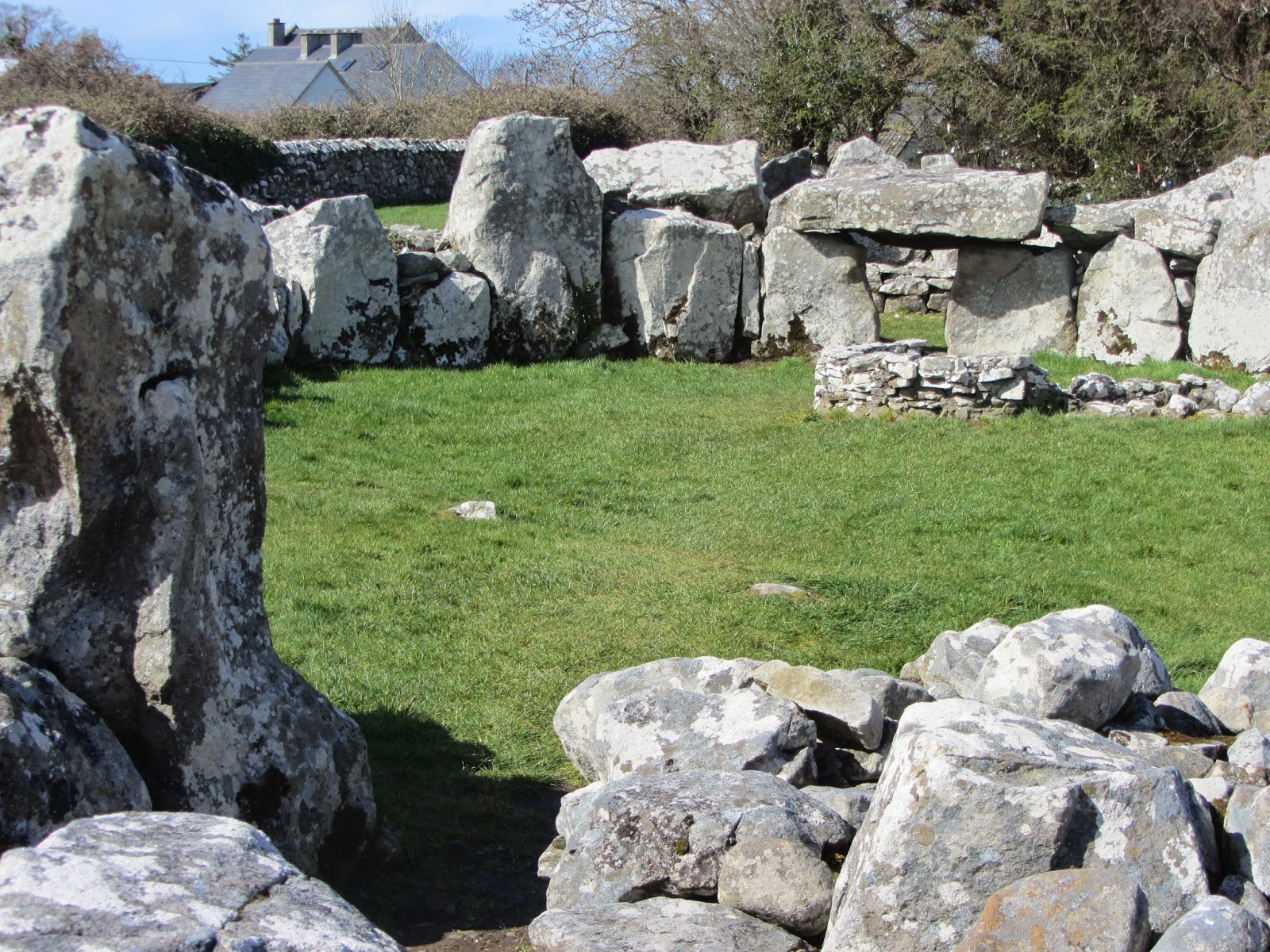 |
| Court with Christian Feature top right |
Large areas of the court were
paved with small flat slabs while in places, cobble stones and sea sand from
the nearby shore was also found. Archaeologists found evidence of large fires
within this enclosed area as well as fragments of cremated bone and charcoal. The
standing stones (orthostats) around the court are quite massive chunks of local
sandstone. They get larger approaching the opening at the rear of the court,
which gives access to an inner chamber, now roofless but which was originally
covered with massive corbels, making an artificial cave.
It is unclear whether the eastern
end was originally the higher as well as the broader, as is generally the case
with these monuments. However, the excavation showed that the builders had used
the natural slope of the ground to obtain the effect of height at this end.
Court-tombs date from the
Neolithic Period and are found mainly in the northern half of the country. Most
of these sites are to be found north of a line extending from Dundalk to Galway.
Their most distinctive feature is the ceremonial court which is set in front of
a gallery or galleries divided into two or more burial chambers.
The court usually occupies one
end of a long cairn but sometimes there are courts and chambers at both ends of
the cairn. In other examples, as in the case of Creevykeel, the court is completely
enclosed within the cairn and is of circular or oval shape, access being gained
through a short narrow passage leading to the front of the cairn.
These megalithic monuments
usually had two functions: the chamber to serve as a tomb, and the courtyard to
accommodate some form of ritual. Objects were often buried with the deceased,
as the first Neolithic farmers believed in life after death.
Excavations at Creevykeel
uncovered four cremation burials, decorated and undecorated Neolithic pottery, flint
arrow heads, polished stone axes, a flint knife, stone bead, four blue glass
beads, a small bronze broach and stud, part of a red deer antler handle, part
of a comb and other artefacts, including a clay ball.
Over 133 stone axes alone have been discovered along the shores
of Lough Gara. Stone axes are normally ascribed to both the Mesolithic and the
Neolithic periods. Polished stone axes, however, seem to appear first in the
Neolithic while ground axes can belong to the Mesolithic or Middle Stone Age.
These tools were used for cutting, shaping and dressing wood. A small
polished stone axe was also found during excavation of the Drumanone Portal
Tomb close to Lough Gara.
 |
| Kiln from Early Christian Period |
Inside the court area
archaeologists discovered a kiln dating from the Christian Period together with
evidence of iron-smelting. Iron Age and early Christian metalworkers seem to
have liked working in ancient sites including crannogs. Such ancient sites may,
perhaps, have held magical properties in relation to metalwork.
Archaeologists excavating a
crannog at Lough Gara in the townland of Sroove found a small bowl-shaped
depression that may represent the shape of a small bowl-furnace for
iron-smelting. Nearby, was found remains of slag, some pieces of which had the
red clay remains of the furnace attached to them.
Creevykeel Court Tomb remains one
of the best examples of its type in Ireland and is well worth a visit if you
happen to be in that part of North Sligo which has a rich megalithic tradition.


 Posts
Posts


