 |
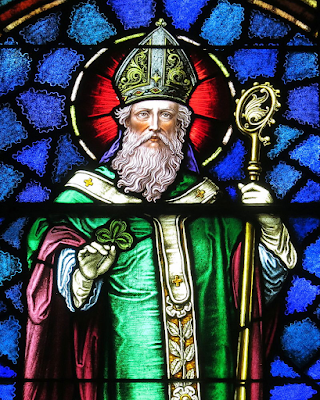
| Stained glass image of St. Patrick. Photo: Wikipedia |
Place of Birth
Much
controversy surrounds the details of St. Patrick's life. He is believed to have been British by birth, the
son of a decurio or town councillor.
His place of birth is said to have been somewhere in the west between the mouth
of the Severn and the Clyde. He was
born sometime between 385 and 389. Patrick himself tells us he was of Romano-British origin. The names of his
parents were Calpurnius and Concessa.
Captured Slave
While still a youth he was captured by Irish pirates and
reduced to slavery. For six years he herded swine or
sheep in Co. Antrim or on the coast of Co. Mayo. During the period of Patrick's captivity in Ireland he learned the native language and got to know the pagan practices of the Druid priests.
Escape
St. Patrick eventually escaped and returned to his family. However, he
was constantly troubled by visions of the pagan
Irish imploring him to walk among them once more.
Ordained Bishop
Patrick was later ordained a bishop and in the year 432 AD he returned
to Ireland. He knew very well that if he was to succeed
in Ireland then he must first convert the kings and
chieftains. Otherwise, the people would not be
allowed to worship in peace. He faced many
dangers including assassination, the military might of kings, and opposition of
the powerful druids whose very existence he threatened.
First Church
It was the Chieftain Dichu who gave Patrick a plot of land on which to
build his first church in Co. Down. St. Patrick spent many years in Ireland
although exactly how long we do not know. During this time, he travelled
extensively. He writes:
“I journeyed among you, and everywhere, for your sake, often in danger,
even to the outermost parts beyond which there is nothing, places where no one
had ever arrived to baptise or ordain clergy or confirm the people.”
Celtic Religion and Art
Ireland, in those days, was quite different from Britain in many ways: it had its own language, political structures, customs and laws. It had not been invaded by Roman legions. It was also located at the furthest reaches of the known world.
 |
| Decorated Grave Slab from Carrowntemple, Co. Sligo (Replica) |
We can also see the merging of pagan and Christian art as Christianity
gradually replaced paganism. Two of the grave slabs at Carrowntemple, Co.
Sligo, bear art of the Early Christian period that is derived from the Celtic
art of the preceding Pagan Iron Age. One of these is close to a design in the
Book of Durrow and is datable to c. 650 AD. Several of the panels of the
seventh century Moylough Belt-shrine, found only a few miles west of
Carrowntemple, have this same mix of Pagan and Christian artwork.
Early Irish texts suggest that holy wells may have remained associated
with non-Christian rituals and were even protected by the old religion. For
example, it is believed that wells were used instead of baptisteries in
Ireland, which may explain the substantial number of holy wells throughout the
country.
In some respects, the nature of the Celtic religion helped in the development of Christianity. Their belief in the indestructibility of the souls of the dead helped in understanding the resurrection of Christ. The Celts also had their own sacrifices and ritual meals which, in a sense, mirrored aspects of Christian message.
 |
| Lough Gara formerly known as Loch Techet |
Patrick Travels to the West
We know from ecclesiastical history that he travelled to the west of
Ireland. After visiting Elphin and Croghan, he came around the north of Loch
Techet, the ancient name for Lough Gara, through the present townlands of
Cuppenagh and Templeronan. It is said that he went to Gregraidhe of Loch
Techet. The Gregraidhe (horse people) or Gregory comprised the baronies of
Coolavin in Sligo and Costello in Mayo. According to an entry in the Annals of
Tigernach (AU 665) Cummeni, Abbot of Clonmacnoise, was of the Gregraige of Loch
Techet.
When the tribe responded to the Gospel, an enclosure would be set aside,
with boundaries and ‘termon’ crosses, sometimes with a ditch, sometimes with a
wall, clearly marking out to everyone that the area was sacred. Within it a
tiny church of wattle and daub would be built.
Monasteries
Many monasteries were built at tribal meeting places or on tribal
boundaries. As monastic communities grew, they attracted a resident local
community. The monasteries provided for the spiritual needs of local families
and taught the children. The monastery and the village grew together. Monks
undertook tasks such as the creating and copying of literature and highly
specialised metalware.
According to Tirechan, the Bishop of North Mayo, Patrick came from the
plain of Mirteach, between Castlerea and Ballaghaderreen, to a place called
Drummut Cerrigi or Drumad of the Ciarraige. This is now the townland of Drumad
in the Parish of Tibohine. It is said that he dug a well here and no stream went
into it or came out of it, but it was always full. The well was named Bithlan
(i.e. ever full).
Here, the saint found two brothers, Bibar and Lochru, the sons of
Tamanchend, fighting about the division of their father's lands. St. Patrick
reconciled them by a miracle, and he blessed them and made peace between them. The
brothers gave their land to Patrick, and he founded a church there.
Patrick then went to Aileach Esrachta which was at Telach Liac or Telach
na Cloch, which later became known as Tullaganrock in the Parish of Kilcolman.
It is said that local people were afraid of the stranger and the eight or nine
men accompanying him, so they decided to kill him. The crowd was restrained by
a brave man named Hercait of the race of Nathi. Hercait and his son Feradach
were babtised and Feradach joined St Patrick. Patrick gave Feradach a new name
calling him Sachail. He eventually became bishop and was associated with a
famous church called Basilica Sanctorum which is now known as Baslik - a parish
between Castlerea and Tulsk.
 |
| Croagh Patrick, Co. Mayo. Photo: Wikipedia |
Patrick spent forty days and
nights fasting on the top of Croagh Patrick, Co. Mayo. Archaeologists have discovered the remains of a church/oratory
dating from the early Christian period on the top of this mountain. The entire summit was enclosed by a stone wall which may have been the enclosing wall of an
early monastic site.
Death
We are told that when the shadow of death came near, Patrick returned to the first church he had built at Soul, Co. Down and died on March 17th, 461. There is, however, some uncertainty as to the
actual year of his death.
Legend has it that St.
Patrick expelled snakes from Ireland, explained the Trinity using the shamrock,
and accomplished single-handed great
missionary tasks of conversion. Scholars doubt if there were ever snakes in
Ireland.
St. Patrick remains the most popular of Irish saints. In art, he is usually depicted wearing the vestments of bishop treading on snakes. In the National Museum of Ireland shrines survive of his bell and his tooth (12th & 14th century). His fame has spread throughout the world, and we celebrate his feast day on 17th March.
https://www.youtube.com/watch?v=DIphXep4nSQ


 Posts
Posts


