Thursday, September 26, 2019

Eleanor of Aquitaine and Bradwell Abbey


Front view of the stone carving of Eleanor of Aquitaine

 that was discovered. (Milton Keynes Council)

           Bradwell Abbey in Milton Keynes, Buckinghamshire, has been in the news recently with the discovery of a carved stone head believed to be of Eleanor of Aquitaine. The discovery was made during conservation work. Eleanor of Aquitaine was one of England’s most powerful queens and one of the most important women in medieval Europe. Scholars are excited about the find as there are very few contemporary artistic representations of the queen.
Bradwell Abbey Chapel
Bradwell Abbey
Bradwell Abbey was founded around 1154 and dissolved during the English Reformation. The carving is thought to date from the 12th century. Around 181 hectares of land were granted to Meinfelin (Lord of Wolverton) for the establishment of a Benedictine priory to the west of Bradwell.
In common with many small priories, the number of monks in the Abbey seems to have always been small. The famine of 1316 struck the Buckingham area hard with contemporary accounts of people being found dead from starvation at the side of the road.  This was followed by the Black Death (1348-1350), which caused heavy mortality in the Buckingham area, particularly amongst monastic orders. At the dissolution of the priory, the dormitory had accommodation for only five monks.
Around 1330, after the famine and before the Black Death, the surviving chapel of St. Mary dedicated to "Our Ladie of Bradwell" was built against the west front of the church. Under the Act for the Suppression of Minor Houses, Bradwell Priory was given to Cardinal Wolsey, by papal consent in July 1524.
Eleanor of Aquitaine. (Rezo1515 / CC BY-SA 4.0 )

Queen Eleanor of Aquitaine
Eleanor of Aquitaine (1122-1204), was one of the most remarkable women in the Middle Ages. She was born to William X, Duke of Aquitaine, the most powerful noble in France and upon her father’s death controlled more territory in France than the king himself. She married the French monarch Louis VII in 1152 but they were later estranged, and their marriage was annulled. She married the future Henry II of England, a monarch who ruled from southern France to Ireland, which is known as the Angevin Empire. Her marriage to the English king, who was 11 years her junior, was turbulent and many believe that she encouraged her sons to rebel against their father.
King Henry of England
On 25 October 1154, Henry became king of England. Eleanor was crowned queen of England by the archbishop of Canterbury on 19 December 1154. Over the next 13 years, she bore Henry five sons and three daughters: William, Henry, Richard, Geoffrey, John, Matilda, Eleanor, and Joan.
His realm extended from Ireland to the Pyrenees. King Henry II was the first king of the Plantagenet dynasty and brought a new level of organization to the English government. Henry II was also the first to establish an English presence in Ireland. He spent just 14 years in total on English soil. Henry 11 is credited with being a careful administrator who overhauled the English judicial system.

Henry and Thomas à Beckett
Henry’s reign was marked by disputes with his chancellor, Thomas à Beckett, who was also archbishop of Canterbury. Ultimately, the story goes, Henry said, “Will no one rid me of this turbulent priest?” Four knights rode to Canterbury, called Thomas a traitor and tried to drag him outside. Thomas refused to go and said, “No traitor but a priest of God.” The knights struck him on the head with their swords. He fell to the floor of the cathedral, dead.
Revolt and capture
In March 1173, annoyed at his lack of power and spurred on by Henry's enemies, his son Henry launched the Revolt of 1173–1174. Eleanor was imprisoned for 16 years, much of the time in various locations in England.
Henry lost the woman believed to be his great love, Rosamund Clifford, in 1176. He had met her in 1166 and had begun their liaison in 1173, allegedly contemplating divorce from Eleanor. This notorious affair caused a monkish scribe to transcribe Rosamund's name in Latin to "Rosa Immundi", or "Rose of Unchastity".
When Henry II died, her eldest son Richard I (the Lionheart) became king and Eleanor became his key advisor. On the death of Richard, her other son John was crowned King John I.
King Richard I effigy
Church of Fontevraud
Richard I of England
Richard I was King of England from 1189 until his death. He also ruled as Duke of
Normandy, Aquitaine and Gascony. He was an extremely able military leader famous for his several victories in the battlefield, the most celebrated being against Saladin, the Muslim leader during the Third Crusade.
King John
King John
John was King of England from 1199 until his death in 1216. He lost the Duchy of Normandy and most of his other French lands to King Philip II of France, resulting in the collapse of the Angevin Empire. His reign was marked by disputes between John and his barons and bishops. King John is best remembered for granting Magna Carta in June 1215, although he sought its annulment almost immediately.
The Crusades 
The Crusades were organized by western European Christians after centuries of Muslim wars of expansion. Their primary objectives were to stop the expansion of Muslim states, to reclaim for Christianity the Holy Land in the Middle East, and to recapture territories that had formerly been Christian.
In 1147, Eleanor accompanied her husband on the Second Crusade, travelling to Constantinople and Jerusalem. The Second Crusade failed because the Christian armies were not able to take control of Edessa or Damascus. The result was a victory for the Muslim forces and a defeat for the Christians in 1149
Church of Fontevraud Abbey
Eleanor of Aquitaine Effigy
Conclusion
Although further research may be needed to verify that the head is that of Eleanor of Aquitaine, who was both Queen of France and England, this discovery is exciting. Perhaps, Queen Eleanor made a pilgrimage to Bradwell? Eleanor died in 1204 and was entombed in Fontevraud Abbey next to her husband Henry and her son Richard. By the time of her death she had outlived all her children except for King John of England and Queen Eleanor of Castile.


Wednesday, July 31, 2019

Walking the Camino

Arriving in the main square, Santiago

Our Pilgrimage
Pilgrim, who calls you?
What secret power draws you? (Anon.)

Santiago was the destination of one of the great pilgrimages of the Middle Ages. Pilgrims set out from all over Europe and converged as they crossed the Pyrenees and entered Spain. Then the Way of St James led to the great cities of Burgos and Leon and on to the shrine in the Field of the Star (Campus Stellae – Compostela) where the bones of St James were believed to lie and now a magnificent cathedral stands.
In early July, together with my son John, we walked as a group of 24 pilgrims from Sarria to Santiago de Compostela in northwest Spain, a distance 70 miles. King Alfonso IX died at Sarria in 1230 while on pilgrimage to the great shrine and his remains lie in the Cathedral of St James the Great. Our walk took us through beautiful undulating Spanish countryside with shady oaks, quiet country roads, sleepy villages with small stone churches and through forest track in the eucalyptus woods.
The Mount of Joy where medieval pilgrims first saw
the spires of Santiago Cathedral
We visited the Romanesque fortress-church of San Nicolas (13 c) in Portomarin. In 1962 the valley was flooded by the creation of the Belesar reservoir. The entire town was moved to higher ground on the west bank. The stones of the façade of the Church of San Pedro (1182) and those of the -church of San Nicolas were numbered to aid reconstruction when the town was moved. At Lavacolla early pilgrims washed themselves in the river before their arrival in Santiago. At the Mount of Joy (Monte Del Gozo), medieval pilgrims first saw the spires of Santiago Cathedral.
Stone carving of Our Lady
Santiago
One of the few carved stone images depicting Our Lady when she was about six months pregnant can be seen decorating an old building in Santiago Old Town. She is shown with her left hand touching her stomach.
In the Middle Ages, Santiago, together with Rome and Jerusalem, were regarded as ‘great pilgrimages’. Santiago was, and still is, one of the largest centres of pilgrimage in the Christian world. The cathedral is the reliquary of the Apostle St James. The first church over the tomb of the Apostle was built by King Alfonso II in around 830-840.
The Apostle James
The Apostle James was one of Jesus’ closest disciples and was present at some significant events in the Gospels including: The Healing of Jairus’ Daughter (Mark 5:21-24a and 35-43); The Transfiguration (Luke 9: 23-36) and in the Garden of Gethsemane (Mark 14: 32-42). He was killed by King Herod. The supposed tomb of St James discovered in 813 led to increase in the number of pilgrims to Santiago and the building of the original church. In 899 a new cathedral was consecrated and in 1075 the second cathedral was begun. The third cathedral was started in 1100. In 1181 a Papal Bull confirmed Santiago’s status as a major pilgrimage site.
After 1300 the number of pilgrims visiting Santiago declined due to the Black Death, wars and schism. In 1879 excavations at the cathedral revealed the reburial site and relics of the Apostle. In 1884 the relics were authenticated by Pope Leo XIII and replaced under the high altar. In 1948 pilgrimage and Holy Year were publicised outside Spain and the number of pilgrims grew. Pope John Paul II visited Santiago in 1982 and again in 1989. Pope Benedict XVI’s official visit to Spain in 2010 began at the cathedral.
Fording a stream in Galicia

My lasting image of the Camino is walking along narrow country lanes, through small stone-walled fields, with a profusion of foxgloves on either side all seeming to point towards Santiago de Compostela. When the Lord scattered those seeds, did He think of a pilgrim like me, I wondered? I would like to think that he did!

Monday, July 22, 2019

210,000-Year-Old Homo sapiens Skull Oldest Outside Africa

A 210,000-year-old human skull found in Greece
Source: Esben 468635/Adobe stock

The website https://www.ancient-origins.net/ reports that a 210,000-year-old human skull found in Greece in the 1970s could provide new evidence that our species left Africa much earlier than previously thought. If the claim is verified, the discovery will rewrite a key chapter of the human story, with the skull becoming the oldest known Homo sapiens fossil in Europe by more than 90,000 years.
Early Expansion not Maintained
The first fossil evidence for any modern humans outside Africa comes from the Middle East, from the archaeological sites of Skhul and Qafzeh in Israel, dating to around 120,000 years ago. However, this early expansion of modern humans was not maintained. A change to a colder climate may have driven those pioneers back into Africa. The expansion of our own species out of Africa that eventually led to the colonisation of the globe would start later – after 100,000 years ago.
A re-evaluation of early human remains and artefacts from Morocco has pushed back the advent of Homo sapiens by 100,000 years. Archaeologists and palaeontologists now think that the oldest of the fossils comes from 300,000 to 350,000 years ago. Skulls, teeth, and long bones of at least five Homo sapiens, along with stone tools and animal bones, have been found at Jebel Irhoud, Morocco since 2004.
Stone Tools
Although stone tools were found all over Africa by 300,000 years ago, human fossils were thought to be no older than 195,000 years old. One possibility was that the stone tools had been made by some hominid (any member of the group consisting of all modern and extinct humans and great apes - including gorillas, chimpanzees, and orangutans - and all their immediate ancestors) other than Homo sapiens. Jebel Irhoud is the oldest and richest African Middle Stone Age hominin site that documents early stages of the Homo sapiens.
Hominins, which may have originated in Africa up to 6 million years ago, include all the species that emerged after the Homo genus, split from that of chimpanzees. Humans and chimpanzees are very closely related and separated about 7.4 million years ago.  There is only a 1% difference between the chimpanzee genome and our own suggesting that we have a common ancestor.
Apidima 2 and its reconstruction.
(c) Katerina Harvati, Eberhard Karls: University of Tubinggen

Apidima Cave
The human skull from Greece was one of two cranial fossils found in Apidima Cave, on the southwestern coast of the Peloponnese in Greece. Both were initially identified as Neanderthals. The discovery of these skulls provides evidence of an earlier migration of people from Africa that left no trace in the DNA of people alive today. One skull was very distorted and the other incomplete. The more complete skull appears to be a Neanderthal. But the other shows clear characteristics, such as a rounded back to the skull, diagnostic of modern humans.
A multinational team from the University of Tubinggen in Germany, led by Katerina Harvati, reconstructed the specimens digitally and dated them by measuring their radioactive decay and confirmed that the skull known as Apidima 2 was an early Neanderthal dating from around 170,000 years ago. Scientists also digitally recreated the skull known as Apidima 1 and found that it was more likely a modern human (Homo sapiens), dating it to 210,000 years ago.

Human fossils from Daoxian and Zhirendong
Palaeontologists have discovered modern human fossils from Daoxian and Zhirendong in China dating to between 80,000 and 120,000 years ago. DNA studies indicate that there was early interbreeding between African humans and Neanderthals.
The new evidence from Apidima further extends our understanding of modern human dispersal and interaction with other hominin species. Human evolution has been thought of in terms of new species developing and replacing older simpler ones. Modern humans were thought to have left Africa and moved across the world from around 70,000 years ago replacing the Neanderthals in Europe about 40,000 years ago.  New fossil discoveries, improvements in their dating and the advent of genetic evidence, has led to a reappraisal of the distribution of modern humans.
Adult Male Cranium 'H.naledi'
from Lesed 1 Chamber, Naledi, South Africa

Neanderthals, Homo naledi and Denisovans
Evidence from modern day Israel, Syria, Lebanon and Jordan, suggest the first wave of modern humans out of Africa were replaced by Neanderthals, before the final, more successful human migration that followed. In southern Africa, modern humans were alive at the same time as a much smaller and seemingly more primitive species called Homo naledi . Genetic evidence from Siberia and Tibet has identified a new hominin species – the Denisovans – that shared a history of interbreeding and interaction with Neanderthals. DNA analysis of our own genomes shows that the Neanderthals bred with our own species.
People living today who are of European, Eurasian, and Asian descent have well-identified Neanderthal-derived segments in their genome. Present-day Africans, however, do not have detectable traces of Neanderthal DNA in their genomes. This shows that whatever sexual contact occurred between modern humans and Neanderthals happened among humans who left the African continent. 
People living outside Africa today trace their ancestry to a migration that left the continent around 60,000 years ago. As modern humans moved across Europe and Asia, they largely replaced other species they met, such as the Neanderthals and Denisovans.
Cranial features of Modern Man and Neanderthal compared

If at least some early modern humans left Africa more than 210,000 years ago, they may have settled in the Levant (Iraq, Syria, Lebanon, Cyprus, Turkey, Israel and Jordan) before expanding west into Europe, which was already home to Neanderthals. Scientists believe that any early human pioneers who did reach Europe died out there, before the Neanderthals themselves were replaced by an influx of Homo sapiens about 40,000 years ago.
Conclusion
A 210,000-year-old human skull found in Greece in the 1970s could provide new evidence that our species left Africa much earlier than previously thought, becoming the oldest known Homo sapiens fossil in Europe by more than 90,000 years. Some experts, however, question whether the skull really belonged to a modern human. Concerns have also been expressed about the dating procedure used. For now, at least, the jury is still out on this recent ‘Earth breaking’ discovery!
For further information see:
https://www.ancient-origins.net/

Monday, May 20, 2019

The Irish Beaker People

Newgrange Passage Tomb

In previous blog posts I discussed the Beaker culture, characterised by its bell-shaped pottery, including DNA evidence for the movement of these early people. When the Beaker culture arrived in Britain and Ireland 4,500 years ago, it was brought by migrants who almost completely replaced the existing inhabitants within a few hundred years. Beaker burials are distinctive and include Beaker ware or pottery.
In his paper Into the west: placing Beakers within their Irish contexts, the author Neil Carlin, points out that the Beaker culture in Ireland is viewed as being rich in settlement evidence. Funerary evidence, on the other hand, is more scarce consisting primarily of collective burials in original megalithic tombs or as secondary burials in earlier sacred sites. Evidence of the Beaker people has also been found in cists and pits.
Example of Beaker Pottery
Beaker Artefacts
Ireland is known for its Beaker-associated copper industry. For example, Beaker pottery was found during the excavation of an ore-processing camp connected with the Early Bronze Age mine at Ross Island, Co. Kerry. Neil Carlin’s paper lists the following items as examples of Beaker origin: polypod bowls, wrist-bracers, V-perforated buttons, basket-shaped earrings, early gold discs, lunulae, copper daggers, small disc beads, small convex scrapers, barbed and tanged arrowheads as well as hollow-based arrowheads.
In Ireland, different types of Beaker objects are rarely found together but in Britain several different Beaker associated objects tend to occur together in the same context. The dating of the Beaker evidence in Ireland remains poorly understood although one archaeologist has argued that the use of Beaker ceramics continued from 2500/2400 to 1900 BC. Finds of beaker pottery in Ireland are mainly found in pits along with artefacts such as lithic, burnt and unburnt animal bone and the charred remains of cereals and fruit.
Stone-lined Pit
At Monadreela, Co. Tipperary, a stone-lined oval pit produced evidence for in situ burning and contained 110 sherds from at least 10 Beakers, fragments of cremated human bone, a large quantity of hazelnuts and acorns together with a small polished stone axe.
Burnt mounds are the most common prehistoric monument in Ireland with over 7,000 examples identified. At Cherrywood, Co. Dublin, a spread of burnt stone and charcoal consisted of two layers that produced ten sherds of Beaker pottery from one pot, 33 lithics including a convex scraper and two hammer stones, and an animal tooth. The tooth was radiocarbon dated to 2400 -2100 BC. Under the mound were eight troughs one of which contained sherds of Grooved Ware.
Early Bronze Age Burial
(c) asi-louth.ie
Wedge Tombs and Cists
Beaker pottery has been recovered from at least 13 of the 25 wedge tomb sites excavated and has been associated with human bones often from collective burials including inhumations and cremations. The construction of wedge tombs has been dated to the period 2400-2050 BC.  
Beaker pottery has been found in eight cists together with burials. At Gortcobies, Co. Derry, fragments of cremated human bone accompanied by convex scrapers, sherds of Late Beakers and a pygmy bowl were recovered from a rectangular stone chamber at the centre of an oval cairn. Neil Carlin points out that, overall, there are very few Beaker grave goods from cists.
Gold lunula, Monaghan
(c)National Museum of Ireland
Portal Tombs and Passage Tombs
Beaker finds from portal tombs are much less common and are usually associated with disturbed deposits. Beaker pottery has only been found in one portal tomb at Poulnabrone, Co. Clare, where two Beaker sherds and a hollow-based arrowhead were found. However, these could not be positively associated with human remains from this tomb.
V-perforated buttons have been found in four passage tombs, including the Mound of the Hostages at Tara, Co. Meath, where three were found in the passage. One button was associated with a bronze awl and a crouched inhumation with a bowl beside its head. A disk bead necklace was also found in the passage with another crouched inhumation and two bowls.
Many Beaker objects have been found in natural locations such as bogs, mountains and rivers. Neil Carlin points out that copper metalwork is mainly retrieved from bogs which have produced 46% of all axes (n= 400) and 40% of all daggers (n= 15). Sixteen of the 44 lunulae and two possible gold discs have all been found in bogs. Battle-axes were mainly deposited in rivers. Only two out of 15 copper daggers and a single lunulae have come from rivers and lakes.
Conclusion
In Ireland, only a relatively small number of burials with Beaker artefacts have been identified which contrasts with the situation in Britain. Most of the pottery is been found in pits while many of the non-ceramic artefacts come from natural places such as bogs.
Bowl-inhumations, which consist of a crouched inhumation within a cist accompanied by a pot beside the head, appear to represent the Irish version of Beaker burials after 2200 BC. These burials tend to be accompanied by grave goods including boars’ tusks, flint scrapers, arrowheads, knives, awls and bangles, bone toggles, belt rings, beads and buttons of jet-like materials.
Neil Carlin notes:
Currently, there is no evidence to suggest a direct association between the construction of any large-scale earthen monuments and the use of Beakers in Ireland. In fact, no monuments apart from one possible pit circle, a few ring ditches and many wedge tombs and cists were created by Beaker users. This differs strongly from the association of Beakers with the erection of monuments like Silbury Hill and possibly also the Stonehenge blue stones in the south of Britain.
Reconstruction of a Beaker burial
(c) National Archaeological Museum of Spain, Madrid.
Beaker objects in Ireland do not seem to have shared the same associations with the dead that these objects did in Britain. It has been suggested that deposits in graves related to the individual and those if natural places with the wider community. Neil Carlin suggests that this may indicate that there was not the same preoccupation with individuality that has been proposed for Britain. In Ireland, communal identities were expressed through the construction and use of wedge tombs and the re-use of Neolithic megalithic tombs.
For further information see:
Into the West: placing Beakers within their Irish contexts.

In A. M. Jones & G. Kirkham (eds.) Beyond the Core: Reflections on Regionality in Prehistory, 2011
OXBOW Books 2011

Thursday, April 25, 2019

New Human Species Discovered in the Philippines


The excavation site at Callao Cave, Luzon Island, Philippines.
(c) Callao Cave Archaeology Project
A new human relative?
A recent article featured on www.ancient-origins.net reports that researchers working in a cave in the Philippines claim to have found a new, previously unknown, species to add to human history. This hominin (any member of the group consisting of all modern and extinct humans and great apes - including gorillas, chimpanzees, and orangutans - and all their immediate ancestors) was probably less than four feet high and had some of the characteristics of modern people but also anatomical features from much earlier hominins. 
The latest in a series of finds of early humans in the Philippines was made by archaeologists as they were digging in the floor of Callao Cave on Luzon island. A team of experts, led by Professor Philip Piper, from the Australian National University, found several fossils unlike anything else in the world. The fossil remains included adult finger and toe bones, as well as teeth. The femur bone of a juvenile was also unearthed. The remains are estimated to be about 50,000 years old and date from a time when several human species co-existed on the planet.
Five upper teeth of a single individual provisionally named 'Homo luzonensis
(c) Callao Cave Archaeology Project
The height of the new humans was determined by the size of the tooth and the other bones although more evidence is required to confirm this. This newly discovered species may be related to Homo floresiensis found on the Indonesian island of Flores which was also under four feet in height. The new species of human had ‘long, curved fingers and toes’ suggesting that it was as comfortable scrambling up trees as walking upright. This previously unknown species has been provisionally named Homo luzonensis.

Humans Migrated ‘Out of Africa’ a Lot Earlier than Previously Thought
It is now known that modern humans evolved in Africa around 300,000 years ago before migrating to other continents. In January 2018 a group of archaeologists from Tel Aviv University working at Mount Carmel, Israel discovered the upper jaw bone of a Homo sapiens in a layer of sediment with tools previously attributed to Neanderthals. This discovery pushed back the date for human migration out of Africa by about 40,000 years confirming the theory that there was more than one expansion phase with different groups leaving over a long period.
The Neanderthals thrived in Europe for around 300,000 years before modern humans arrived. Excavations in Ibex, Vanguard, and Gorham’s Caves in Gibraltar have revealed evidence of Neanderthal occupation dating to possibly as late as 28,000 years ago. This makes Gibraltar the most recent Neanderthal occupation site yet discovered. The ancestors of modern humans interbred with Neanderthals and another extinct line of humans known as the Denisovans. Modern humans, Neanderthals and Denisovans shared a common ancestor who lived roughly 600,000 years ago.

Humans and chimpanzees are very closely related and separated about 7.4 million years ago.  There is only a 1% difference between the chimpanzee genome and our own suggesting that we have a common ancestor. Homo sapiens represents the last of a long line of hominin races that once consisted of five different species spanning four continents.
Homo Sapiens Sophistication
Most human traits are found in lesser degrees in other species. Researchers point out that humans, compared to other apes, are highly social, primarily use culture to adapt to their environment, and are very skilled at language. These traits have allowed humans to be much more adaptable and resilient in the face of a changing environment. Other animals, including great apes and dolphins, have capacities for abstract thought and language skills but these abilities are especially pronounced in Homo Sapiens.
Thanks to new techniques, including advances in DNA analysis, it is now possible to learn more about extinct species of human than ever before. The evidence is pointing not to one unbroken chain of human ancestors but a rich family tree with several offshoots. Our family tree is now filled with not only direct ancestors like Homo Habilis and Homo Erectus but also cousins and distant relatives like Homo Neanderthalensis and Homo Denisova.
Homo Heidelbergensis
Homo Heidelbergensis or Heidelberg man walked the earth about 600,000 years ago in Africa, parts of Asia, and Europe and is believed to be the direct ancestor of Neanderthals. They were using stone tipped spears to hunt large prey and may be the first species of homo to intentionally bury their dead.
Homo Denisova
One of the more recent discoveries of an extinct human species was made at the Denisova Cave in Siberia as recently as 2008. Advances in DNA analysis has made it possible to sequence the genome of Homo Denisova. Some people in Tibet have traces of Denisovan DNA in the same way that some Europeans have a minute percentage of Neanderthal DNA. In 2018, some ten years after the discovery of Homo Denisova, at the Denisova cave a small fragment of bone was positively identified as the direct offspring of a Neanderthal and a Denisovan. The female offspring, nicknamed ‘Denny’, had survived to approximately 13 years of age.
Skeleton of Neanderthal Child found at Roc de Marsal, Dordogne, France
(c) Musee National de Prehistoire
Neanderthals May Have Pioneered Cave Art
In 2018 scientists revealed the origins of some cave art in Spain was Neanderthal rather than human. The discovery supports the theory that Neanderthals and modern humans were not as different to one another as previously presumed. An international team of scientists dated the calcite (crystal) layer which had formed on top of the ancient artwork and concluded that the art must have been there beforehand and must be older than it. Results revealed the artwork predated the arrival of modern humans in the region by a minimum of 20,000 years.
Conclusion
Researchers in the Philippines claim to have found a new, previously unknown, species to add to human history. The remains are estimated to be about 50,000 years old and date from a time when several human species co-existed on the planet. This new species has been provisionally named Homo luzonensis and was probably less than four feet tall. This exciting discovery gives new meaning to the phrase ‘We are not alone’!
For more information please see:
https://www.ancient-origins.net/news-history-archaeology/new-human-species-0011725
https://www.ancient-origins.net/human-origins-science/11-mysterious-extinct-human-species-0011564


Sunday, April 7, 2019

Raising a glass to the Beaker People


Beaker Culture Diffusion
from Wikipedia
Introduction
A recent paper entitled The phylogenealogy of R-L21: four and a half millennia of expansion and redistribution by Dr Flood, a former Principal Research Scientist at The Commonwealth Scientific and Industrial Research Organisation, provides some interesting insights into population changes in Britain and Ireland over a period of 4,500 years. Dr Flood argues that it is likely that the L21 genetic mutation originated in the large Beaker colony in south-west Britain around 2,500 BC. From there, it was carried by sea into north-west France, Ireland, north-west Spain and the Middle Rhine, which today have a high incidence of L21, and into Northern England and Scotland.
Around 100 BC, a second major R-L21 expansion was initiated in Ireland and Scotland. Dr Flood suggests that this is consistent with a collapse in the population of Ireland, followed by a rapid expansion. It is thought that a severe weather event, famine and/or epidemic occurred around this time. Famine, plague and war tend to be closely associated. Ireland has suffered regular severe famines, as has Northern Europe more generally.
Ireland’s isolation meant that there were many diseases to which the Irish would not have acquired immunity. Examples of diseases that later devastated the New World include smallpox, influenza, typhoid, yellow fever and pertussis. Typically, these diseases wiped out 95% of newly exposed populations.
Genetic Change
Every movement of people throughout history has produced different challenges. The environment and the way that humans lived meant that the genetic code of different branches of human beings mutated. Within a population group those individuals with a certain mutation may have greater survival rates than those without. Those without the mutation would die at a faster rate and therefore the mutated gene spreads.
One reason many Africans are naturally resistant to malaria is because 33,000 years ago the genetic structure of the African population group changed (mutated). Because Europeans had already migrated out of Africa, they did not carry this mutation and therefore many are not resistant to malaria.
Reconstruction of Beaker Burial
Beaker People
When the Beaker culture extended to Britain and Ireland 4,500 years ago, it was brought by migrants who almost completely replaced the existing inhabitants within a few hundred years. The assumption that people today are directly descended from the people who always lived in that same area no longer stands. Human populations have been moving and mixing throughout history. These people have been credited with introducing metalworking to Britain and spreading the Indo-European language group.
In genetic terms, L21 is a major branch of the general Y-haplogroup R1b that has dominated Western Europe since the early Bronze Age. About 37 per cent of men in the British Isles are R-L21, and two-thirds of the Irish.
The Vikings
From about 793 AD Viking raiders from Scandinavia began to assault the coastline of the British Isles. The Vikings occupied most of the Scottish Isles and the Isle of Man initially and established large port settlements at York, Dublin and along the south and east coast of Ireland. These invaders took huge numbers of slaves to run their agricultural holdings, mostly from now overpopulated Ireland and Scotland. It is reported that in a single day, they took 1000 slaves from Dublin and their genetic inheritance is visible today. It is thought that about 90 per cent of Nordic L21 men may be descended from slaves taken in raids.
The Diaspora
From the 1840s, much of the population of Ireland, Scotland and Cornwall went abroad as economic refugees. About 10 million Irish have emigrated and today over 40 million North Americans claim Irish heritage. Following the Highland Clearances and the dissolution of the Clans around 1750, the Scots began to emigrate, and today around 50-million people identify as being of Scots or Scots-Irish heritage, even though the population of Scotland is only 5.3 million.
The dating of the L21 mutation to around 2,500 has been supported by the presence of Bell Beaker sites all over Britain and Ireland dating from before 2400 BC. For example, Cornwall has an abundance of Beaker sites including round barrows and cairns, henges, stone circles and stone cist graves. The Cornwall/Devon area was a major dissemination point for R-L21 and is likely to have had the first large settlements in Britain.
Dalriada Overkingdom
The situation in Scotland is complicated by an invasion of the west coast of Scotland by Irish Gaelic speakers who eventually seized power from the Picts and gave Scotland its rulers, its Gaelic language and its name. Dr Flood argues that the expansion of the mutation M222 in Scotland is the only clear example of a concerted move by the Ui Neill group into Scotland, establishing the Dalriada overkingdom of Argyll and Antrim.
Bottlenecks in our genetic history
A population ‘bottleneck’ occurred around 74,000 years ago when the volcano that produced Lake Toba in Indonesia erupted and ejected 2,800 cubic kilometres of volcanic ash. Sunlight was blocked out through the entire Southeast Asia, South Asian and Arabian Peninsula and ash formed a thick layer on the floor. Only 10,000 people are thought to have survived this cataclysmic event, and these are now known as our distant ancestors.
Example of Beaker Pottery
Conclusion
The genetic mutation known as L21 originated in the large Beaker colony in south-west Britain around 2,500 BC. The Beaker people expanded over a period of a few hundred years, creating widely separated colonies in north-west France, Ireland, north-west Spain, the Middle Rhine and into Northern England and Scotland. These people have been credited with introducing metalworking to Britain and spreading the Indo-European language group. The so-called Bell Beaker, which gave the culture its name, may even have been used to drink alcohol!

Around 100 BC, a second major R-L21 expansion was initiated in Ireland and Scotland. Later invaders of Britain such as the Belgae, Saxons and Normans had a British genetic mixture from the early Bronze Age. Researchers believe that the human genome has been subject to irregular pruning including considerable decreases in genetic diversity probably resulting from natural disasters, epidemics or warfare. Perhaps we should raise a glass to these early people – slainte!
For further information see:

Monday, February 4, 2019

Must Farm – Post Excavation

Various pots during the pottery re-fitting exercise
Photo: (c) Must Farm Website

In an earlier blog post I wrote about the Must Farm settlement in Cambridgeshire, England, which is one of the most complete Late Bronze Age examples known in Britain. The settlement consists of five circular wooden houses, built on a series of piles sunk into a river channel below and seems to have been built around 1300 – 1000 BC. The houses were subsequently destroyed by fire.
Specialist Analyses
The months of excavation work have now been followed by a series of detailed scientific investigations exploring the Must Farm settlement in much finer detail. The results of this post excavation analysis so far are detailed on the Must Farm website. Almost 50 specialists are currently working on investigating 37 different aspects of the settlement focusing on its material, environmental samples and dating the site scientifically. It is during this wide-ranging specialist investigation that theories and interpretations developed during the excavation can be tested or expanded.
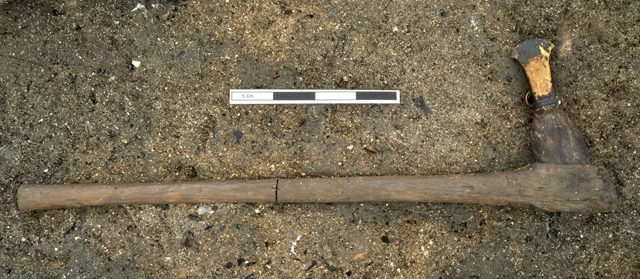
Selection of socketed axes
Photo: (c) Must Farm Website

The excavations at the Must Farm site revealed a varied accumulation of artefacts consisting of metalwork, textiles, animal bone, pottery and much more. Many of the objects were found in remarkable condition while others were fragmented especially the large collections of pottery and animal bone.
At Must Farm the preservation of the material left behind is excellent because of the ideal combination of charring and waterlogging. Textiles, wooden objects and environmental evidence are among the finest examples from the Late Bronze Age found in Britain.
Late Bronze Age socketed axe complete with handle
Photo: (c) Must Farm Website
Wooden Objects
Must Farm has yielded an abundance of wooden objects and implements, many of which have rarely, if ever, been seen in a Late Bronze Age site. Over the 10 months of the Must Farm excavation, archaeologists recorded over 5,000 pieces of wood ranging from woodchips to huge oak timbers.
Residue of food in one of the Must Farm
bowels
Photo: (c) Must Farm Website
Food
One of the most widely reported finds from the Must Farm settlement has been the survival of food remnants inside many of the pots. The fire which destroyed the structures helped these organic materials to survive in a very charred form. This raises the tantalising possibility that archaeologists will be able to find out what meals were being prepared at the time of the blaze.
Quern-stone
During excavation of the occupation deposits from the interiors of the collapsed building archaeologists recovered the shattered remains of a flint quern. The flint had been heated to a high temperature inside one of the structures during the large fire which destroyed the settlement. When the floor collapsed and the heated quern hit the water, it shattered.
The flint quern-stone has an exceptionally flat surface unlike many prehistoric examples. Characteristically, when a stone quern is used for grinding, the surface develops a prominent indentation from constant rubbing with the hand-stone. One possible explanation is that the quern was new and simply had not been used enough to develop a depression. This interpretation would support the theory that the settlement had not been lived-in for long before being destroyed by the fire.
Socketed bronze axe
Photo: (c) Must Farm Website
Metalwork
The Must Farm site also produced a large collection of metal tools and weapons for specialists to study. The different types of axe all date to roughly the same period during the Late Bronze Age. Many of these axes are incredibly well used and have been sharpened many times. This wear on the blades is likely to have been due to the construction of the settlement, which would have required extensive cutting and shaping of hundreds of timbers.
Environmental Conditions
The buildings at Must Farm were built on stilts, situated above a river channel, before being destroyed by an intense fire. Archaeologists noted patterns amongst the material that suggested a strong association between objects and their original positions within the Must Farm buildings.
Initial environmental evidence suggests that the river channel was shallow and slow moving, supporting the initial view of archaeologists that the material at the base of the river channel had not travelled far from where it would have fallen. Analysis of pollen data and plant remains, for example, has provided a more detailed understanding of the river channel. While it was suspected that the river was sluggish and shallow, the environmental data suggests that at times it may have been almost dry.
The study of plant remains, and related evidence indicates that the river channel had dense reeds along its course and, importantly, underneath the structures. Archaeologists suspect that the reeds created a “hairbrush” effect, catching artefacts and debris as the structures burned and their floors collapsed.  This had the effect of slowing the material as it was deposited into the channel. Artefacts simply dropped directly below the stilted buildings, thereby, reflecting their original position inside the structures.
Image showing palisade posts
Photo: (c) Must Farm Website
Footprints from the Past
During the excavation archaeologists revealed preserved footprints surrounding the palisade. It seems very likely that these groups of footprints were the result of people involved in the construction of the palisade during a time when the river was dry or shallow. Animal hoofprints are present alongside those of humans suggesting the presence of various species at the site during the construction. This amazing glimpse of a moment in the creation of the palisade over 3,000 years ago helps connect us to the people involved in the creation of the Must Farm dwellings.
Animal Bone
A range of different animals was recorded at the site including wild boar and red deer. The most prominent feature of the animal bone was a preference for wild meat rather than the domestic types typically associated with sites of this period in the Bronze Age. The inhabitants of Must Farm appear to have had definite preferences for certain joints of meat with red deer and boar forequarters present in several of the houses. Around the outside of each of the site’s structures is a “halo” of bone fragments that seem to reflect the waste of meal preparation.

Conclusion
The settlement at Must Farm has one of the most complete Bronze Age collections of artefacts ever discovered in Britain, giving us an unparalleled insight into the lives of the people who lived there 3,000 years ago. As archaeologists and various specialists examine the vast array of samples from this site, we can look forward in the coming years to learning much more about this fascinating and remarkable Late Bronze Age site and the Bronze Age generally.


For more information please see: