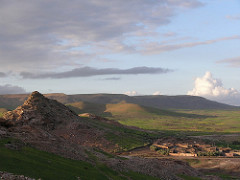
Friday, December 22, 2017

Ötzi the Iceman

Ötzi the Iceman
Occasionally, a chance discovery brings us literally face to face with our ancient past. Bog bodies, which are usually well preserved, are one example of such finds. Perhaps, the best-known discovery of a mummified body in Europe is ‘Ötzi’ the Iceman.
About 5,300 years ago, Ötzi was shot with an arrow, struck on the head, and left to die near a mountain pass high in the Alps. In 1991, hikers near the Italian-Austrian border discovered his body in a glacier. Ötzi is the oldest mummy in Europe. What can he tell us about our Neolithic ancestors: how they lived, the tools and weapons they used, and the clothing they wore?

Where he came from
The research confirmed that modern Sardinians are Ötzi's closest relatives. However, he most closely resembled prehistoric farmers found in Bulgaria and Sweden. Ötzi was a native of Central Europe and not a first-generation émigré from Sardinia, according to new research.
The new findings support the theory that farmers, and not just the technology of farming, spread during prehistoric times from the Middle East all the way to Finland.

Where he grew up
Ötzi wasn't far from home when he died. Scientists concluded that he didn't live in the Alps as such, but spent most of his life in Isack Valley or the lower Puster Valley, in the northernmost part of what is now Italy. He probably spent the last 10 years of his life in an area south and west of his previous home, not far from where he died.
Contact between people who lived south and north of the Alps at this time was thought to have been limited. However, people who travelled in the Alps had a very deep knowledge of the landscape and its conditions due to their experience with hunting, herding, and exploring natural resources in these areas. It is thought likely that Ötzi traded furs or domestic animals.

His equipment
The Neolithic herdsman carried several pieces of equipment when he died, including numerous wooden tools that were used to make clothing or utensils. Among the equipment he carried was an axe of almost pure copper thought to have been a status symbol, indicating that he ranked high in his pastoralist culture. Its wooden handle and leather straps were still preserved. Ötzi was also carrying a bow and arrow, which he had leaned against a tree before he died.
Copper Axe found with Ötzi's Body
Researchers have now traced the source of the metal in Ötzi’s axe to southern Tuscany. It had been thought that people living around the Alps at that time got their copper locally or from the Balkans.

Another copper axe
Archaeologists have found a copper blade in Switzerland resembling the axe Ötzi was carrying when he died. It was made from copper that also came from Tuscany. The axe was discovered in Zug-Riedmatt, one of the many pile-dwelling villages around the Alps famous for their prehistoric wooden houses built on stilts on lakeshores and other wetlands. This new axe was between 5,300 and 5,100 years old and missing its wooden handle. 

Clothing
Most of Ötzi's clothing was badly disintegrated, but researchers did manage to retrieve parts of his sheep and cow leather shoes, goatskin leggings, bear fur cap, and animal skin loincloth. The iceman also carried a grass mat or cape with him, either to sleep on or shield him from the rain.
Some of the Clothing Worn by Ötzi the Iceman
Ötzi wore garments made from the skins of different animals. His leather overcoat was made from at least four different individual animals from two species of sheep and goat while his lighter coat was made of sheep. His leather shoes were stuffed with grass, with shoelaces made from wild cow or auroch (an extinct species of large wild cattle that inhabited Europe, Asia, and North Africa. It is the ancestor of domestic cattle).  His furry hat was made from brown bear while his quiver was made from a roe deer.

His health
Scientists found that the Iceman had tooth decay, ate an agricultural diet, and had Lyme disease. The oldest red blood cells ever identified have been found in his body. Ötzi suffered from heart disease and joint pain before he died. Analysis of his skeleton revealed he had bad knees and was lactose intolerant.

His relatives
Scientists sequenced Ötzi's entire genome and compared it with those from hundreds of modern-day Europeans, as well as the genomes of a Stone Age hunter-gatherer found in Sweden, a farmer from Sweden, a 7,000-year-old hunter-gatherer iceman found in Iberia, and an Iron Age man found in Bulgaria. Researchers have established from genetic analysis that Ötzi has living relatives in the region.
Ötzi and his present-day relatives share a common ancestor, who may have lived 10,000 to 12,000 years ago. His mother's family appears to have originated in the Alps and did not spread from there.  Researchers concluded that Ӧtzi's maternal line appears to have died out as the genetic lineage does not exist in modern populations alive today.

Probable cause of death
Scientists estimate that Ötzi was 45 years of age when he met his violent death in the mountains. His last meal included red deer meat with herb bread. The probable cause of his death was an arrow wound to the shoulder that sliced an artery.
The fact that he had an undigested meal in his stomach suggests the Iceman was ambushed, but scientists couldn't agree whether he was bashed over the head or killed by an arrow that nicked an artery in his shoulder. In a 2012 study, scientists analysed the mummy's red blood cells and concluded that Ötzi bled to death after the arrow wound.

Ötzi today
Ötzi's perfectly preserved body is stored in a specially designed cold storage chamber at the South Tyrol Museum of Archaeology in Italy at a constant temperature of -6°C (21°F).

For further information see:


Friday, December 15, 2017

It’s all in the Genes


My mother’s people came from somewhere in the Sahara Desert. They were nomads who lived around 16,500 years ago, moving from place to place, carrying all their possessions with them. My DNA test results have helped to throw some light on my ancestors, and perhaps yours, and the journey they made to reach the West of Ireland
Ireland's remote geographical position has meant that the Irish gene-pool has been less susceptible to change, and the same genes have been passed down from parents to children for thousands of years. Research into both British and Irish DNA indicate the people of both islands have much in common genetically. The closest genetic relatives of the Irish in Europe are to be found in the north of Spain in what is now known as the Basque Country. We share this common ancestry with the people of Britain and with the people of Scotland.

The following quote comes from the general preamble to my results.

 “It is important to consider, understand and perhaps deeply appreciate the fact that the very concept of race is man made. We live on one planet. Borders and modern day political countries are purely created by man and do not resemble genetics.
There is no such thing as a French, British or German person, as, in fact, people, from what is today called Germany, and people, from what is today called Syria, are more closely related genetically than two people from Uganda living in adjoining villages.
Genetic blueprints are very much shaped by:
Immigration – Warfare – Migration – Intermarriage – Conquest – Choices
Therefore, our DNA is a unique combination of genetic markers that are found all over the world.
We are all made up of all of us.”

Quote from ‘The story of your ancestry as never told before’

William Murphy
Famine (1997) on the Custom House Quay in Dublin
Photo; Flickr

 
The test looked at three areas of my genetic code: Fatherline (Y-DNA) History, Motherline (mtDNA) History and Family Ancestry (autosomal DNA) and the results are summarised in the table below. The test results provide a genetic code or a ‘genetic signature’ which is then compared with various populations providing a percentage frequency by geographic area. We can then see where people with our code originated and migrated.

Summary of my DNA test results


Fatherline (Y-DNA) History

Motherline (mtDNA) History

Haplogroup: R-M222
Haplogroup: H1
Subclade: R-DF109

A predominantly Irish branch of the R-L21 fatherline.

Haplogroup H is predominantly European, originating around 16,500 years ago.

My fatherline signature belongs to the R-M222 group.

H1 is found as far as Africa, Central Asia, and Siberia
Ireland – 25%
Scotland – 10%
England – 10%
Wales – 5%

Norway, Sweden, France, and Orkney Islands – 1% each

Populations from southwest France, Sardinia and the Iberian Peninsula show the highest levels of H1 within Europe

Tuareg (Fezzan) – 61%
Basque – 27%
Portugal – 25%
Ireland – 16%
United Kingdom – 16%

Ireland – 25%
Scotland – 10%
England – 10%
Wales – 5%

Norway, Sweden, France, and Orkney Islands – 1% each


Fatherline (Y-DNA) History

The Y chromosome (YDNA) is passed down from father to son, which is referred to as the ‘fatherline’. It is the sex chromosome that determines you are male. So only sons inherit the Y chromosome from their father.
The haplogroup is a collection of related family lines we are connected to through the Y chromosome (YDNA). Apparently, I share a common ancient ancestor with all the people who share my haplogroup. Haplogroups can be associated with geographic regions, and are also used to trace the ancient migrations of early humans.

R-M222 is a branch of the larger R-L21 fatherline, which is itself a branch of the much larger R1b fatherline which was carried by waves of Indo-European expansions, and which is very common throughout Western Europe. R-L21 is associated with the northern Atlantic shores of Europe today, especially in parts of Britain and Brittany. The R-M222 branch of this fatherline is most frequently found in Ireland.
Subclade R-DF109 is a predominantly Irish branch of the R-L21 fatherline and examples of its distribution in modern society include: Ireland (25%), Scotland (10%), England (10%) and Wales (5%).

Motherline (mtDNA) History

Haplogroup: H1
Haplogroup H is predominantly European, originating around 16,500 years ago. Apparently, my motherline signature belongs to the H1 group. It has been suggested that the carriers of haplogroup H were involved in the recolonisation of Europe from the Ice Age refuge locations. Examples of the distribution of H1 in present-day society are: Tuareg (61%), (The Tuareg people inhabit the Sahara Desert, in a vast area stretching from far southwestern Libya to southern Algeria, Niger, Mali and Burkina Faso.), Basque (27%), Portugal (25%), Ireland (16%) and United Kingdom (16%).

Family Ancestry (autosomal DNA)

Family ancestry (autosomal DNA) – looks at ancestry over approximately 5-6 generations

Great Britain and Ireland 95.8%
Europe (North and West) 2.6%
Europe (South) 1.7%

Great Britain and Ireland – 95.8%
Southwest Scotland and Northern Ireland – 36.6%
Ireland – 20.9%
East Anglia – 13.4%
Europe (North and West) – 2.6%
Scandinavia – 2.6%
Europe (South) – 1.7%
Basque – 1.7%

Family ancestry (autosomal DNA)

Autosomal DNA is passed down from all our ancestors and the combination makes up our genetic code. A typical code provides the genetic history going back approximately 10 generations. This gives a percentage estimate against the population groups that my genetic code is compared against. For example: Great Britain and Ireland (95.8%), Southwest Scotland and Northern Ireland (36.6%) and Ireland (20.9%).

Great Britain and Ireland: Ireland

Ireland was unaffected by the Romans and Anglo Saxons who invaded and settled in neighbouring Britain but did feel the undesired impact of the Vikings from Scandinavia. The genetic influence of the Viking invasion may be much smaller than the considerable cultural influences that resulted from the settlements and raids of the Vikings from 795 AD.
Researchers can still detect the DNA of Nomadic Stone Age people that first settled Britain at the end of the last ice age – the same signature that can be found in western Germany, north western France, and Belgium today. The population of Wales is thought to be the most closely related to the earliest, most ancient settlers who migrated over after the last ice age. Not only is Wales genetically unique but North Wales is even genetically different from the south.

Modern Humans - Migration

Scientists believe that Modern humans (Homo sapiens) first appeared around 200,000 years ago in what is now known as Africa. However, a re-evaluation of early human remains and artefacts from Morocco has suggested that the advent of Homo sapiens may have to be put back by 100,000 years. Archaeologists and palaeontologists believe that the oldest of the fossils comes from 300,000 to 350,000 years ago.
Current scientific understanding shows us that no modern humans ventured outside Africa before c.120,000 years ago. The first large scale migration out of Africa happened around 65,000 years ago. Humans reached India, Australia, and New Guinea 50,000 years ago. This was followed by a wave of migration into the Middle East and then into Europe c. 45,000 years ago. Finally, migration into the Americas took place within the last 15,000 years.

Migration Map
Wikipedia

             The direct maternal and paternal lines of all individuals living today come together in single groups of people from around 200,000 years ago.

Genetic diversity out of Africa

 Two individuals from neighbouring villages in Uganda can have greater genetic difference than two individuals living in the areas now known as Europe, India, or Asia. This shows how genetic diversity is very limited in modern human beings outside of Africa.

Our changing genes

Every movement of human beings has produced different challenges. The environment and the way that humans lived meant that the genetic code of different branches of human beings mutated. Within a population group those individuals with a certain mutation may have greater survival rates than those without. Those without the mutation would die at a faster rate and therefore the mutated gene spreads.
Researchers tell us that the reason many Africans are naturally resistant to malaria is because 33,000 years ago the genetic structure of the African population group changed (mutated). Because Europeans had already migrated out of Africa, they did not carry this mutation and therefore many are not resistant to malaria.
DNA is a powerful tool which is increasing understanding of our ancient ancestors, where they came from, how they lived, and the journeys they made over many thousands of years. My mother was born and died in the same house in Co. Roscommon, and the Sahara Desert was a distant place. She did, however, recall carrying farmyard manure on her back as a child to fertilise the land - like her ancient ancestors who carried their possession across the desert sands.

For further information you may wish to view the following YouTube videos:


Friday, November 17, 2017

The Lion Man: an Ice Age Masterpiece

Lion Man from three angles. Stadel Cave, Baden-Württemberg, Germany, 40,000 years old. © Ulmer Museum.
The British Museum in London is currently holding an exhibition entitled ‘Living with Gods’ which runs until 8th April 2018. Among the exhibits on show is a remarkable carved figurine called Lion Man which is on loan from the Umber Museum in Germany.
The Lion Man sculpture found in Stadel Cave, Baden-Württemberg, Germany, made from mammoth ivory, has been described as a masterpiece. It is 40,000 years old providing the oldest known evidence of religious belief. It stands 31 centimetres tall and has the head of a cave lion with a partly human body. This is the oldest known depiction of a being that does not exist in physical form but symbolises ideas about the supernatural. In 2017, UNESCO acknowledged Stadel Cave as a World Heritage Site.
Found in 1939, scholars believe that the Lion Man makes sense as part of a story that might now be called a myth. The wear on his body caused by handling suggests that he was passed around and rubbed, perhaps, as part of some ritual.  An experiment using the same sort of stone tools available in the Ice Age indicates that Lion Man took more than 400 hours to make.
Archaeological discoveries in other caves in this region include small sculptures often found with large amounts of stone tools and animal bones that indicate people lived in the shelter of the daylight areas of these sites. Hybrid creatures, half-man and half-beast also appear in cave drawings in France.
The Lion Man. Stadel Cave, Baden-Württemberg, Germany, 40,000 years old. The oldest known evidence of religious belief in the world. © Ulmer Museum.
Lion Man may represent a shaman whose preferred costumes were often hides of the more dangerous Ice Age animals. A shaman is a person who acts as intermediary between the natural and supernatural worlds, using magic to cure illness, predict the future and control otherworldly forces. From ancient times, the lion has been viewed as a symbol of the masculine virtues of courage and strength. Shamans still exist today in the Amazon region and Australia.
Stadel Cave, where the Lion Man was found, is different. It faces north and does not get the sun. It is cold, and the concentration of debris accumulated by human activities is much less than at other sites. Lion Man was found in a dark inner chamber, carefully put away in the darkness with only a few perforated arctic fox teeth and a cache of reindeer antlers nearby.  Archaeologists think that Stadel Cave was used as a place where people would come together occasionally around a fire to share a particular understanding of the world expressed through beliefs, symbolised in sculpture, and acted out in rituals.
Many fragments were overlooked in the cave when the pre-war dig was abruptly terminated due to the outbreak of World War 11. However, archaeologists have recently discovered previously unknown fragments of the figurine and are piecing it back together. This work has prompted some experts to question if, perhaps, the 40,000-year-old statue represents a female shaman? Scientists hope to resolve a decades-long debate.
Those who believe that Lion Man is in fact a woman are convinced that primitive societies were matriarchal. An image of a 14,000-year-old human body with an animal head discovered in the Las Caldas cave in Spain is obviously female. The head looks like that of an ibex, while the lower part of the body is clearly female.
Prehistoric religion reflected people’s need to understand the world and explain disasters. Through rituals and offerings, ancient societies sought to bribe or appease the divine forces controlling the world or its individual components. Since Neanderthal times, people have practised rites that showed concern for their dead, perhaps linked to a belief in an afterlife.
These new revelations offer a greater insight into the mind of the prehistoric sculptor, who created the figure some 40,000 years ago. His ancestors had migrated to Europe, which had been controlled by the Neanderthals, shortly before.
Lion Man has provided us with at least some insight into religious belief and practice 40,000 years ago. We can never hope to understand the mindset of these ancient people, but the significance of this tiny figurine is clear from the sheer number of hours it would have taken to make it. It is worth pondering that this work was undertaken at a time when our early ancestors would have struggled simply to survive during harsh climatic conditions.

For further information please see:

Friday, September 29, 2017

Urlaur Abbey - County Mayo

 
Urlaur Abbey - County Mayo
The Dominican Friary (Abbey) at Urlaur was founded in 1434. A papal bill dated 18th March 1434, issued by Pope Eugene IV granted Fr. William Nangle and Fr. Thomas O’Grogan permission to remain in Urlaur and erect a regular monastery. Edmond Costello and his wife, Fineola Cusa, daughter of O’Connor Dun, were generous benefactors and they financed the building of the Abbey. It became the burial place of the Costellos.
The Church is rectangular with doorways in the western and southern walls, windows and three gothic arches. There is an aperture where lepers could rest and hear Mass. The Abbey also had other buildings such as the kitchens, the refectory, the boathouse for a quick escape and, up the steps, the dormitory where the friars slept.
The Urlaur Pattern is still held each year on the 4th. August to remember the feast of St. Dominic. The chief duty of the Dominicans was to preach. They also helped the sick and lepers and provided shelter for pilgrims and travellers though living on charity themselves.
The Dominicans are named after their founder Saint Dominic who was born in Spain in 1170. He chose a life of penance and poverty and gathered together a band of preachers in southern France in the early part of the 13th century. The preachers were sent to cities where the Universities and other seats of learning were to be found. The Dominican Friars came to Oxford and London in 1221 and to Dublin in 1224 and are known as the Order of Friars Preachers. The Order spread quickly through Ireland forming communities and churches. Twenty-Four Dominican communities were founded in Ireland in the thirteenth century.
In 1385, the MacDermots Roe are said to have established the Dominican Priory of the Holy Cross at Cloonshanville, near modern day Frenchpark in County Roscommon. Theobald Dillon got possession of Cloonshanville after the dissolution of the Monasteries. The Dillon’s settled in Ireland after the Norman Conquest in 1169 and were a landlord family from the 13th century in a part of County Westmeath called 'Dillon's Country'.
Four Altars
It is said that Myles Costello who lived in Creggane-na-gCrann erected the Four Altars, near Ballaghaderreen, sometime between 1720 and 1750. He was a descendant of the Costello’s of Castlemore. The priest who celebrated Mass at Ateen-taggart in Bockagh, near Ballaghaderreen, also read Mass here when circumstances permitted and usually resided with the Costello family in Creggane-na-gCrann. Rev. Thomas Costello, whose family built the Four Altars, died on 21st March 1846 at the age of 77 years and is buried beside the St John’s Church in Tiverton, Devon.
The Costello’s of Tallaghanmore or Edmondstown were another branch of the family. The last member of this family was Captain Costello who built the residence of the Bishop of Achonry. This latter family became Protestants somewhere around the beginning of the 19th Century. It was said that Sir Robert Peel, who was Chief Secretary for Ireland (1812 to 1818) and later became British Prime Minister, the man who established the Royal Irish Constabulary (the Peelers), regularly visited this family of Tallaghanmore for the shooting season.
Most monasteries in the West escaped suppression until the reign of James 1. Following inquisitions in 1608 and 1610, the friary was declared suppressed and its lands given to Sir Edward Fisher. Later it passed into the hands of Sir Theobald Dillon although the friars went on living quietly at Urlaur.
Stairs leading to the Dormitory
Urlaur Abbey
The situation deteriorated further under Cromwell. Fr. Dominic Dillon and Fr. Richard Overton of Urlaur were put to death at Drogheda. Cromwellians killed a Fr. Mac Costello and Fr. Gerard Dillon died in prison. Despite the mayhem and terror of the time, eleven Dominicans met at Urlaur to discuss the affairs of the Order.
In 1698 the friars were forced to flee the Friary again because of the Penal Laws. Facing the threat of transportation and possibly death, five friars remained in the area including Fr. Pierce Costello and Fr. Redmond Costello. The late 18th century saw the Friary in ruins and a dwindling community. The last friar was Fr. Patrick Sharkey who died in 1843.
‘The Friars of Urlaur’ is dark but highly amusing tale of morality whereby the Friars seek to banish a foul and evil spirit which had invaded their peace. The story appears in ‘Legends of Saints and Sinners’ a book of Irish Christian folklore, collected and transcribed by Douglas Hyde and published in 1915
Some evil spirit found its way to Loch Urlaur. It came at first in the shape of a black boar. One day the friars were walking by the brink of the lake when they saw the big black boar. It let a screech out of it and rose up then on its hind feet screeching and dancing for a couple of hours. Then it leaped into the water and an awful storm followed with lightning and the thunder, and everybody thought that it was the end of the world.
After much tormenting by the creature, the friars enlisted the help of the bishop to rid themselves of the evil spirit. "Seize the villain, seize him," says the bishop. "You didn't seize me yourself," says the villain, "when I was your pet hound, and when you were giving me the meat that you would not give to the poor people who were weak with the hunger; I thank you for it, and I'll have a hot corner for you when you leave this world."
The evil spirt was finally destroyed by a local piper who was said to have done more good on this world than all the priests and friars in the country.
Urlaur Abbey now lies in ruins but the annual pattern held on 4th of August brings locals and visitors to the area. Mass is celebrated in the old Abbey and a sense of peace is evident among the hallowed stones.

For further information please see:

Wednesday, August 2, 2017

St Columba (521-597 AD)

Iona Monastery
Photograph from Flickr
Archaeologists have uncovered conclusive evidence that a wooden hut traditionally associated with St Columba at his ancient monastery on the island of Iona dates to his lifetime in the late sixth century. Samples of hazel charcoal unearthed during an excavation of a wattle and timber structure on Iona 60 years ago have been radiocarbon dated to the period Columba lived in the Iona monastery. The structure is believed to be the monk's "cell" where he prayed and studied in isolation. The results show the hut dated back to between 540 and 650 and Columba died in 597.
In the Life of St Columba, written 100 years after his death by his successor Adomnán, he was described as often writing in his cell on a rocky hillock, called Torr an Aba or "the mound of the abbot". It is believed that the Cathach, a manuscript of psalms reputed to be Columba's own writing, would have been created in his cell.
St Columba at Bridei's Fort
Painting by Joseph Ratcliffe Skelton
(1868-1927)

Much of what we know about St. Columba is due to Adomnán, the ninth Abbot of Iona, and his book, the Vita Colum Cille (Life of Columba). Saint Columba (521 - 597) was an Irish abbot and missionary who is credited with spreading Christianity in what is today Scotland. He founded the important abbey on the island of Iona.
As soon as he was old enough, Columba was taken from the care of his priest-guardian at Tulach-Dugblaise, or Temple Douglas, to St. Finnian's (c 495-c 589) training school at Moville. Later, he attended the famous monastic school of Clonard, headed by another Finnian (470-549), who in later times was known as the "tutor of Erin's saints".
Columba loved books, and spared no effort to obtain or make copies of Psalters, Bibles, and other valuable manuscripts for his monks. His former master, Finnian, had brought back from Rome the first copy of St. Jerome's Psalter to reach Ireland. Finnian guarded this precious volume jealously, but Columba got permission to look at it, and secretly made a copy for his own use.
When Finnian was told of this, he laid claim to the copy. Columba refused to give it up, and the question of ownership was put before King Diarmaid, Overlord of Ireland. His decision in this early "copyright" case went against Columba. "To every cow her calf," reasoned the King, "and to every book its son-book. Therefore, the copy you made, O Colum Cille, belongs to Finnian."
Columba had another grievance against the King. Prince Curnan of Connaught, who had fatally injured a rival in a hurling match and had taken refuge with Columba, was dragged from his protector's arms, and slain by Diarmaid's men. It is said that the war which soon broke out between Columba's clan and the clans loyal to Diarmaid was instigated by Columba. At the Battle of Cul Dreimhne his cause was victorious, but Columba was accused of being morally responsible for driving three thousand unprepared souls into eternity.
Columba's own conscience was troubled, and on the advice of an aged hermit, Molaise, he resolved to atone for his offense by exiling himself and trying to win for Christ in another land as many souls as had perished in the terrible Battle of Cul Dreimhne, near modern day Drumcliff, Co Sligo.
Torr an Abba
                 Site of St Columba's Cell
In 563 AD Columba left Ireland and settled with the Gaels of Dál Riata, where he was granted the Island of Iona to found his monastery. Columba was a useful asset to the Gaelic warrior kings. His monastery provided education for their sons, he was a close advisor to the king, and he served as a diplomat to the king’s neighbours in Pictland and Ireland.

His monastery on Iona became world famous. Together with SS Canice and Comgall, he spread the gospel to the Picts. Iona’s fame as a missionary centre and outstanding place of learning ultimately spread throughout Europe, turning it into a place of pilgrimage for several centuries to come.
Adomnán lists Saint Columba's prophetic revelations, which are attributed to the saint's ability to view the present and the future at the same time. Most of the chapters begin with Saint Columba telling his fellow monks that a person will soon arrive on the island or an event will occur. Columba is said to have displayed some strange behaviours, including banishing women and cows from the island, claiming that “where there is a cow there is a woman, and where there is a woman there is mischief”.
It is said that Columba was prevented from completing the building of the original chapel until a living person had been buried in the foundations. His friend Oran volunteered for the job and was duly buried. Columba later requested that Oran’s face to be uncovered so he could bid a final farewell to his friend. Oran’s face was uncovered and he was found to be still alive but uttering such blasphemous descriptions of Heaven and Hell that Columba ordered that he be covered up immediately!
Another story relates how on one of his journeys, St Columba come across several Picts who were burying the body of a man who had been killed by an aquatic monster which lived in the River Nesa. This story has been interpreted as the first written reference to the Loch Ness Monster. It goes on to say that Columba then saved another man from the monster by ordering the beast to retreat, which it did.
Book of Kells c 800
The monks of Iona produced countless elaborate carvings, manuscripts and Celtic crosses but, perhaps, their greatest work was the beautiful Book of Kells, which dates from c 800 AD, currently on display in Trinity College, Dublin. Shortly after this the Vikings raided Iona and many of the monks were slaughtered and their work destroyed. Within 50 years, they had extinguished the light of this great monastic settlement. Columba’s relics were removed in 849 AD and divided between Alba (Scotland) and Ireland. 
Columba died on Iona in 597, but his monastery’s influence continued to grow, leading to the foundation of new monasteries in Ireland and as far away as Lindisfarne in Northumbria. His feast day is on 9th June.
For more information please see:


Monday, July 24, 2017

The Moneen Cave Skeleton: the harsh reality of 17th Century Ireland

The Burren, Co Clare
Archaeology has the remarkable ability to bring us face to face with the past. During the initial exploration of Moneen Cave, outside Ballyvaughan village in the Burren, Co. Clare, by cavers in June 2011, a human skull was found in the chamber. Subsequent archaeological excavations led to the recovery of further cranial fragments at the same location. The excavation of the site also revealed an artificial rectangular niche and a disturbed human skeleton - minus the skull. Moneen Cave lies close to the summit of Moneen Mountain at an altitude of 166m.
The discovery of the Moneen skeleton brings into sharp focus the hardships endured by many, including children, in the not too distant past. The small size of the skeleton led archaeologists to think it was of a young child. Analysis of the teeth, however, revealed that the remains belonged to someone who had died aged 14 to 16 years old. DNA analysis confirmed the individual was a teenage boy. Investigations of the skeleton revealed incredible details about the boy’s life.
Researchers found evidence of stunted growth, almost certainly a result of malnutrition and hunger. The adolescent measured 4 ft. 1 inch in height which is the equivalent of an average 8-year-old child by modern standards. Scientists discovered evidence on the skeleton of chronic infections and vitamin deficiencies. The bones also revealed evidence of a poor diet with little meat but high in carbohydrates.
Radiocarbon dating in Queen’s University Belfast revealed the teenager had died sometime between 1520 and 1670. There was no evidence to suggest that this individual suffered a violent death. Historian Dr Ciarán Ó Murchadha has suggested that the most likely timeframe for the boy’s death is during the Commonwealth period (1649-1660), when Clare endured nearly two decades of famine, warfare, disease, and mass human casualty.  
Poulnabrone Dolmen, Co Clare
Dr Marion Dowd, IT Sligo, who investigated the Moneen Cave discovery, states:
“All the evidence from the various specialists told us the same thing: this boy suffered periods of extreme hunger and malnourishment every year, probably for the entire duration of his short life. We do not know who he was, but there are a few details we can be certain about. Isotopic analysis by Dr Thomas Kador at University College London indicated the boy was local to the Burren. We can imagine he was born and reared close to Ballyvaughan village.”
How the teenager came to be in the cave is a mystery. According to Dr Dowd:
“We found the remains within a small rectangular niche in the wall of the cave. It was a small space, just about big enough for a teenager to crawl into. The position of the bones suggests the boy curled up in this small space and died there, alone in the cold.”
We can only speculate about the boy’s final hours.
“Perhaps he was seeking refuge - this was a time of religious persecution and political instability - or he may have been ill, or both.” she added.
The earliest object found during excavations in Moneen Cave was a broken flint flake of late Mesolithic or Neolithic date. Archaeologists also discovered a Bronze Age antler hammerhead and over 345 sherds of pottery, analysis of which indicated the presence of at least six different undecorated vessels dated to c. 1100-1000 BC.
It is thought that the material from Moneen Cave may represent votive deposits placed in the cave as some form of religious act. The cave may have been regarded as a sacred place in the landscape. It would appear that Moneen Cave was never occupied as no evidence of habitation, hearths or domestic debris was found and the chamber was extremely small and cramped.
"All in all, the excavation provided a very poignant insight into a life that was harsh and ended tragically for this boy in the not too distant past,” said Dr Dowd.

Whilst we may be shocked by the harsh conditions suffered by a young boy in Co Clare in the mid-1600s, we should not forget that about 795 million people, or one in nine of the World population, suffered chronic undernourishment in 2014-2016 (Food and Agriculture Organisation, The State of Food Insecurity in the World 2015). Almost all the hungry people (780 million), live in developing countries whilst there are 11 million people undernourished in developed countries. 

For more information please see:


Marion Dowd (2013) About a boy: excavations at Moneen Cave in the Burren. Archaeology Ireland,                   Vol. 27, No. 1 (Spring 2013), pp. 9-12 Published by: Wordwell Ltd. 


Monday, June 19, 2017

In Search of our Ancient Ancestors – New Evidence


View from Jebel Irhoud
Photo: Flickr
A re-evaluation of early human remains and artefacts from Morocco has pushed back the advent of Homo sapiens by 100,000 years. Archaeologists and palaeontologists believe that the oldest of the fossils comes from 300,000 to 350,000 years ago. Skulls, teeth, and long bones of at least five Homo sapiens, along with stone tools and animal bones, have been found at Jebel Irhoud, Morocco since 2004. Prior to this discovery, the oldest accepted dating for Homo sapiens remains were said to be from the site of Omo Kibish in Ethiopia, dated to 195,000 years ago and Herto, also in Ethiopia, from 160,000 years ago .
Although stone tools were found all over Africa by 300,000 years ago, human fossils were thought to be no older than 195,000 years old. One possibility was that the stone tools had been made by some hominid (any member of the group consisting of all modern and extinct humans and great apes - including gorillas, chimpanzees, and orangutans - and all their immediate ancestors) other than Homo sapiens. Jebel Irhoud is considered to be the oldest and richest African Middle Stone Age hominin site that documents early stages of the Homo sapiens.
Composite Reconstruction of Skull from
        Jebel Irhound - Photograph: Flickr
Today, modern humans or Homo sapiens, inhabit the whole earth. Looking back over the last half a million years, the picture was much more diverse, with three distinct lineages appearing: Homo erectus in Asia; and Homo heidelbergensis giving rise to Homo neanderthals in Europe and Homo sapiens in Africa. Excavations in Ibex, Vanguard, and Gorham’s Caves in Gibraltar have revealed evidence of Neanderthal occupation dating to possibly as late as 28,000 years ago.
This dispersal out of Africa is believed to have started from Northeast Africa. Modern humans later spread worldwide, replacing earlier ancestors either through competition or interbreeding. The first fossil evidence for any modern humans outside Africa comes from the Middle East, from the archaeological sites of Skhul and Qafzeh in Israel, dating to around 120,000 years ago.
The skeleton of an adolescent early Homo sapiens was found at the Qafzeh Cave site near Nazareth, buried in a pit dug into bedrock. The skeleton was lying on its back with both arms flexed upwards and a set of deer antlers laid across the chest. The burial dates to around 100,000-80,000 years ago and may represent a form of ritual possibly indicating a belief in an afterlife. However, this early expansion of modern humans was not maintained.
The ancestors of modern humans interbred with Neanderthals and another extinct line of humans known as the Denisovans. Modern humans, Neanderthals and Denisovans shared a common ancestor who lived roughly 600,000 years ago. The interbreeding may have given modern humans genes that bolstered immunity to pathogens. The first clues to ancient interbreeding surfaced in 2010, when scientists discovered that some modern humans — mostly Europeans — carried DNA that matched material recovered from Neanderthal fossils.
There are, however, conflicting models of human expansion. The so called Regional Continuity theory suggests that Homo sapiens arose from earlier, archaic populations in many places throughout the Old World. Over time, archaic populations in Africa, Europe, and Asia developed into Homo sapiens. In this view, the lineages represented by Homo ergaster in Africa, Home erectus in Asia, and Homo neanderthals in Europe have all survived, and modern humans are their descendants.
The recent African Origin model proposes a more localised point of origin for our species. The earliest Homo sapiens fossils are found in Africa, and genetic research on living humans points to the recent evolution of our species in Africa. Genetic evidence also supports a model of expansion, with our species emerging out of Africa and largely replacing earlier, archaic populations.
Sometime after 80,000 years ago, a population expansion and migration began, which would lay the foundations of modern humans colonising the globe. Although the archaeological evidence is not conclusive, the genetic trail leads out of Africa, through the Middle East, into southern and South Asia, and all the way to Australia.
The presence of early Homo Sapiens in north Africa complicates our understanding of humanity arising in the east of the continent. Researchers used to think that there was a cradle of humankind in East Africa about 200,000 years ago, and all modern humans descend from that population. The new finds indicate that Homo sapiens is much older and had already spread across all of Africa by 300,000 years ago.
It’s possible that in the Middle Stone Age early humans spread all over Africa, aided by their new stone technology of smaller, lighter tools such as spear tips rather than larger stone hand axes. At the time, the Sahara was a lush, green savannah and not the impassable desert of today. Alternatively, humans may have already spread throughout the continent and developed Middle Stone Age tools independently.
For further information see:
http://letterfromballinloughane.blogspot.co.uk/2016/12/migration-is-not-something-new.html